Painting Over Powder-Coated Aluminium: A Six-Step Process Guide
Painting over existing powder-coated aluminium can be challenging, but it can be carried out successfully on site when the right preparation sequence and coating system are applied. This guide covers what makes the difference between a finish that lasts and one that fails.
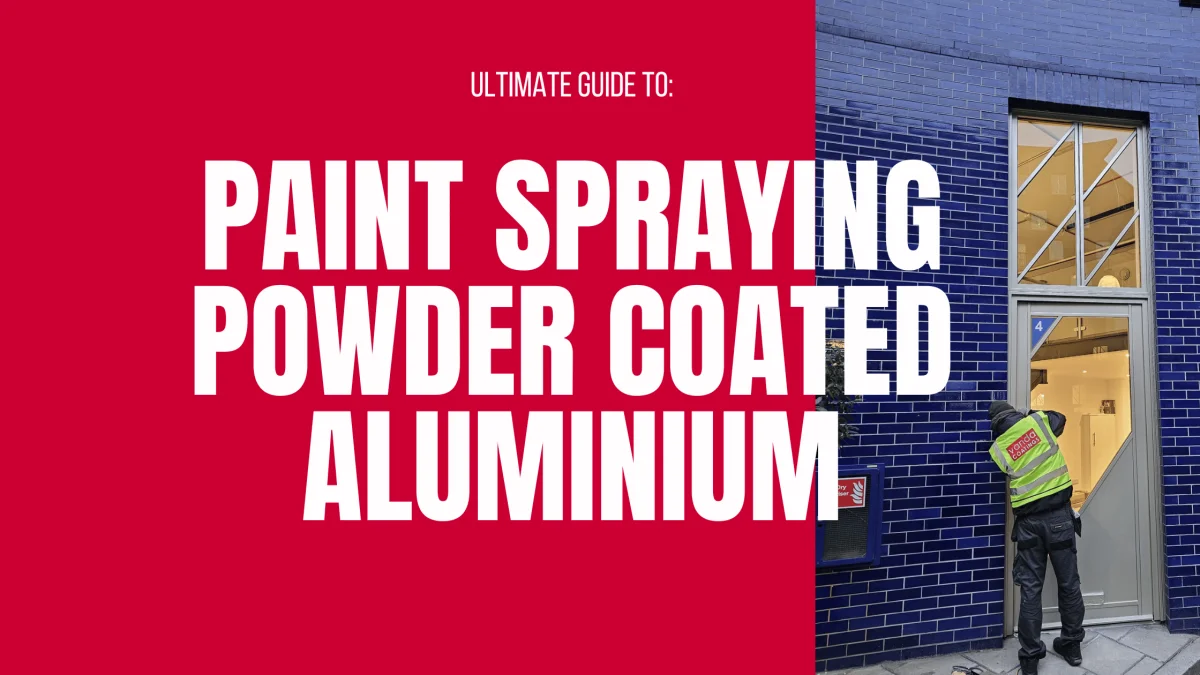
Powder coating emerged as a commercially viable finishing option in the 1960s and quickly became the dominant factory-applied finish for architectural aluminium. Today it is standard on aluminium window systems, curtain walling, shopfronts, doors, balustrades, and a wide range of other architectural components across Britain's commercial building stock. The finish is highly durable, but not permanent. Over time, exposure to UV, moisture, and atmospheric pollutants causes colour fading, chalking, and eventual film breakdown.
When that happens, the question facing property owners and facilities managers is straightforward: re-coat or replace? For the vast majority of commercial buildings, on-site recoating is the right answer on both cost and disruption grounds. But painting over powder coating is not the same as painting over a previously liquid-coated surface, it requires a specific approach to achieve a result that will stand up to further years of exterior exposure.
What is powder coating?
Understanding what powder coating is helps explain why painting over it presents specific challenges. Powder coating is a dry finishing process: a fine thermosetting or thermoplastic powder, most commonly polyester, epoxy-polyester, or PVDF chemistry, is applied electrostatically to the aluminium substrate. The charged powder particles adhere to the grounded metal. The coated component is then passed through a curing oven at temperatures typically between 180°C and 200°C, where the powder particles melt, flow, and cross-link to form a continuous, hard, chemically resistant film.
The result is a surface that is extremely hard, smooth, and chemically inert, excellent properties for durability, but properties that also make adhesion of a subsequent liquid coating more difficult. A liquid coating applied to a smooth, non-porous, chemically inert powder coat without proper surface preparation will have very limited mechanical bond and will be susceptible to delamination under thermal cycling or mechanical stress.
Why paint over powder-coated aluminium?
Four business cases drive the decision to re-coat powder-coated aluminium on site rather than replacing the sections:
- Cost. On-site recoating typically costs 60–80% less than full section replacement, including the cost of temporary boarding, structural work, and reinstatement of any disturbed building fabric
- Disruption avoidance. Occupied commercial buildings, offices, retail units, hotels, cannot easily accommodate the removal and reinstallation of window or shopfront sections. Recoating is carried out with the building in full operation
- Corrosion protection. Faded or chalking powder coat is no longer providing effective corrosion protection to the aluminium beneath. Recoating with a primer and topcoat system restores that protection before structural corrosion can develop
- Colour change or brand refresh. On-site recoating allows a full colour change, giving a building a dramatically updated appearance without any structural work
Substrate assessment: the first decision
Before any preparation work begins, a thorough assessment of the existing powder coat condition determines what is required and whether on-site recoating is appropriate. The assessment should cover:
- Adhesion of existing coating, a cross-cut adhesion test identifies whether the existing powder coat is still firmly bonded to the aluminium substrate. Poor adhesion at this stage means additional preparation will be required to remove delaminating areas before topcoat application
- Extent and type of surface failure, chalking, fading, minor cracking, and edge breakdown can all be addressed through preparation; delamination, blistering, or severe corrosion undermining the coating requires more extensive work
- Substrate condition, check for white rust (aluminium corrosion products, typically aluminium hydroxide) at unsealed edges, around fasteners, and at frame corners. Structural corrosion, pitting into the aluminium section itself, must be assessed for severity
- Original coating specification, where available, knowledge of the original powder coat type (polyester, PVDF, epoxy-polyester) helps with coating system selection
When is recoating not appropriate? On-site recoating is not suitable when the aluminium sections are structurally corroded, dimensionally distorted, or when the frames are no longer sealing correctly and air or water ingress has developed. In these cases, repair of the substrate itself is required before coating, and if the structural damage is extensive, replacement may be the only viable option. A survey will confirm which route is appropriate.
The six-step process for painting over powder-coated aluminium
The process described here is the sequence Vanda Coatings follows for on-site recoating of powder-coated aluminium on commercial buildings. Every step is essential, preparation in particular cannot be abbreviated without compromising the durability of the finished result.
Clean the Substrate
All surfaces are thoroughly cleaned to remove dirt, grease, biological growth, bird droppings, salt deposits, and any other contamination. Soft brushing with a mild alkaline degreaser is the preferred method. Jet washing can be used where pressure is controlled carefully and is not directed at seals, gaskets, or drainage channels. The surface must be rinsed completely and allowed to dry before any abrasion work begins. Contamination beneath the coating system is the single most common cause of early adhesion failure after recoating.
Remove Corrosion
Any areas of corrosion are treated mechanically before the new coating is applied. White rust (aluminium hydroxide deposits at edges and fastener points) is removed using fine nylon scouring pads. Where red rust is present on any ferrous fixings or metalwork associated with the aluminium frame, power sanding removes the active corrosion. All corroded areas are treated back to clean, sound substrate before proceeding. Applying coating over active corrosion will allow the corrosion to continue developing beneath the new film and cause premature failure.
Abrade the Powder Coat Surface
This is the most critical preparation step. The entire powder-coated surface is abraded using fine-grit abrasive pads or paper to remove the degraded outer layer, eliminate any chalk, and, most importantly, create a mechanical key that the new coating can bond to. The abrasion must be uniform across the whole surface, including all profiles, rebates, and face edges. After abrading, the surface is thoroughly cleaned down to remove all abrasive dust before masking begins. Any dust left on the surface will compromise adhesion.
Mask Off Adjacent Surfaces
All glazing, brickwork, stonework, render, sealant beads, and any adjacent surfaces not to be coated are masked off before any primer or topcoat is applied. On occupied sites, masking extends below the working area to protect pavements and surfaces from overspray. Plastic sheeting, masking paper, and decorator tape are used as appropriate. Thorough masking takes time but is essential: overspray on glazing or adjacent masonry is difficult and costly to remove after curing.
Prime the Substrate
An aluminium-compatible adhesion primer is applied immediately after the final clean-down. Primer application must follow cleaning without delay, aluminium oxide forms rapidly on clean aluminium surfaces exposed to air, and applying primer before this occurs maximises adhesion. The primer provides the bonding layer between the abraded powder coat and the topcoat, and provides additional corrosion protection at any areas where the original coating has broken down to bare metal. The primer is allowed to cure fully before topcoat application.
Spray Apply the Topcoat
A commercial-grade two-part acrylic topcoat is spray-applied in the specified colour and gloss level. Airless spraying equipment is used for large flat faces; HVLP is used where a finer finish is required on detailed or visible sections. Multiple coats are applied as required to achieve the specified dry film thickness. The completed coating is inspected for colour consistency, gloss uniformity, and film integrity before the masking is carefully removed. Handover documentation including product data sheets and care and cleaning instructions is provided.
Choosing the right coating system
Not all commercial coating systems are formulated for application over powder coat substrates. The system must be specified to suit the existing coating type, the exposure conditions, and the performance requirements of the project. The key parameters are:
Two-part acrylic topcoats
Two-part acrylic systems are the industry standard for on-site recoating of powder-coated aluminium. They offer excellent adhesion to correctly prepared powder coat substrates, good UV stability, and proven durability in exterior exposure conditions across the full range of UK climates. When cured, they produce a hard, chemical-resistant film suitable for continued exterior exposure without further maintenance beyond regular cleaning.
Avoid interior-grade or single-pack coating systems for exterior powder coat restoration. Interior-grade coatings are not formulated for UV exposure and will degrade rapidly on exterior elevations. Single-pack coatings do not develop the same film hardness and chemical resistance as two-part systems and are not appropriate for surfaces that will be subject to weathering, cleaning, and physical contact.
Primer selection
The primer must be compatible with both the existing powder coat substrate and the chosen topcoat. Etch primers or wash primers formulated specifically for aluminium provide the best combination of adhesion promotion and corrosion protection. The primer and topcoat should ideally be from the same manufacturer's system to ensure compatibility and to preserve any applicable product warranty.
Colour and gloss specification
Recoating allows a full colour change. Any RAL, BS, NCS, or bespoke colour can be matched and supplied in the specified gloss level, from matt through satin to full gloss. Most architectural aluminium is originally specified in satin or semi-gloss; matching the gloss level maintains the character of the building's original design intent. Where a colour change is desired, we recommend viewing a test panel under the actual site lighting conditions before the full application proceeds.
Powder coat restoration versus full replacement: a comparison
| Factor | On-site restoration | Full replacement |
|---|---|---|
| Typical cost | 60–80% less than replacement | High, materials, labour, boarding, reinstatement |
| Programme | 1–5 days typical for commercial unit | Weeks, lead time for new sections plus installation |
| Occupant disruption | Minimal, building remains operational | Significant, security risk during removal, noise, dust |
| Colour change | Full colour change available | Full colour change available |
| Environmental impact | Low, existing material retained | High embodied carbon in new aluminium production |
| Design match | Existing sections retained, exact match | Profile matching to existing can be difficult |
| Suitable when substrate is corroded through | Not suitable, replacement required | Appropriate solution |
What types of powder-coated aluminium can be re-coated on site?
On-site recoating is applicable to virtually all powder-coated aluminium components on commercial buildings, provided the substrate is structurally sound:
- Aluminium window frames and sub-frames, all system types
- Curtain walling and structural glazing frames
- Commercial shopfront frames, transoms, and stallrisers
- Aluminium entrance doors and automatic door frames
- Powder-coated balustrades and handrails
- Fascias, soffits, and architectural trim powder-coated in aluminium
- Internal architectural aluminium, lift lobby screens, atrium features, partition frames
- Roller shutter doors and overhead door systems with powder-coated profiles
Projects handled by Vanda Coatings include recoating of powder-coated commercial atriums with high-level access, multi-storey curtain walling on occupied office buildings, and full shopfront re-colouring for retail brand refreshes, all completed while businesses remained fully operational.
Frequently asked questions
Yes. Painting over existing powder-coated aluminium is achievable on site and produces a durable, commercially acceptable finish when the correct preparation sequence and coating system are used. The key requirements are that the existing powder coat is stable and well-adhered to the substrate, that the surface is thoroughly cleaned and mechanically abraded before coating, and that a primer and topcoat compatible with powder coat substrates are selected. Unstable, heavily cracked, or delaminating powder coat must be addressed during preparation before the topcoat is applied.
Powder coating is a dry finishing process in which a fine powder, typically polyester, epoxy, or polyurethane chemistry, is applied electrostatically to a metal substrate and then cured in an oven at temperatures of 180–200°C. The heat causes the powder particles to melt, flow, and cross-link into a continuous, hard film. Because it is applied and cured in a factory environment, powder coating produces a highly consistent finish with excellent mechanical resistance. The coating cannot be applied on site because an oven is required for curing, which is why on-site liquid coating systems are used for restoration work.
On-site recoating of powder-coated aluminium is chosen over replacement for four main reasons: it eliminates the cost and disruption of removing and reinstalling sections; it is significantly more economical than replacement (typically 60–80% less cost); it protects the substrate from further corrosion without requiring structural work; and it allows a full colour change to support a brand refresh or building improvement programme.
Powder coating is a very hard, smooth, and chemically inert surface, properties that make it an excellent protective finish but that also make it difficult for a liquid coating to bond to without proper preparation. The new coating needs a mechanical key, a slightly roughened surface texture created by abrasion, to anchor to. Without this key, even correctly specified coatings will adhere poorly and are at risk of delamination under thermal cycling or mechanical stress. Thorough abrasion of the entire surface is therefore a non-negotiable step in the preparation sequence.
Project duration depends on the area to be treated, access requirements (scaffold, MEWP, or abseil), and the number of elevations involved. A typical commercial unit, such as a shopfront or a single-storey office entrance, can normally be completed within one to three days. Larger multi-storey or multi elevation projects are typically programmed in sections to minimise impact on building operations. Work is carried out with the building occupied unless ventilation constraints require otherwise.
Recoating allows a full colour change, including a complete departure from the original colour if required. Using commercial coating suppliers, Vanda Coatings can source and match any RAL, BS, NCS, or bespoke colour, with access to any RAL, NCS, or British Standard colour reference, plus spectrophotometric matching. Gloss levels can also be specified: satin, semi-gloss, and full gloss are all available. Colour confirmation is provided prior to application.