Faded Powder Coating: Causes, Prevention & On-Site Restoration
Why powder coating loses colour on commercial buildings, how UV and environmental exposure cause chalking and film breakdown, and what the restoration process looks like when a re-coat is the right answer.
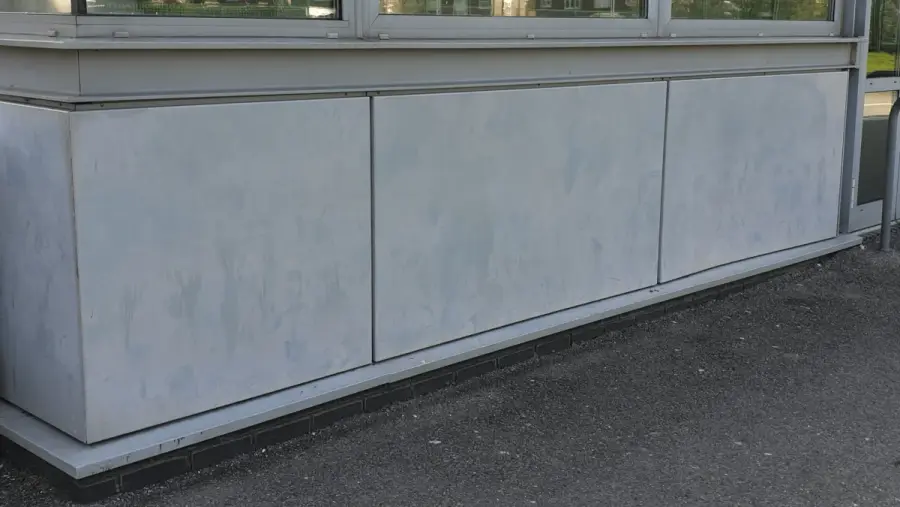
Powder coating is among the most durable architectural finishes available for aluminium windows, doors, shopfronts, and cladding systems. Applied correctly, a quality powder coat should maintain its colour and gloss for 15 to 25 years in typical inland UK conditions. But when it begins to fail, through fading, chalking, or localised breakdown, the change in appearance is visible from street level and can significantly affect a building's kerb appeal and perceived maintenance standard.
If you manage or maintain a commercial building, it pays to understand why powder coating fades and what your options are for restoring it without ripping everything out and starting again.
What causes powder coating to fade?
There is no single reason a powder coat fades. Several things are happening at once, and they compound over time.
UV radiation and photodegradation
Ultraviolet radiation from sunlight is the primary driver of colour loss in powder-coated aluminium. UV energy attacks the polymer binder that holds the coating film together and breaks down the organic pigment molecules responsible for colour. The result is a progressive loss of colour depth and intensity, most pronounced on south- and west-facing elevations where UV exposure is highest. Bright, saturated colours, reds, oranges, yellows, and vivid blues, are particularly susceptible because the organic pigments used to achieve these hues have lower UV stability than the inorganic pigments in whites, greys, and blacks.
Chalking: when the binder breaks down
As UV degradation continues, the polymer binder oxidises and becomes friable. The pigment particles it was holding in suspension are no longer locked into a cohesive film. Running a finger across the surface leaves a powdery residue, this is chalking, and it is a reliable indicator that the coating has passed the point of cosmetic deterioration and the film itself is failing. Chalking surfaces are also more porous, which accelerates moisture ingress and increases the risk of corrosion in the aluminium beneath.
Environmental and coastal exposure
In coastal environments, airborne chloride salts are deposited on building surfaces continuously. Salt disrupts the adhesion bond between the coating and the aluminium substrate and accelerates electrochemical corrosion. Buildings within five kilometres of the coast, or in heavy industrial environments where pollutants create acid deposits, can show visible fading and surface breakdown significantly earlier than comparable buildings in rural or suburban inland locations.
Incorrect cleaning methods
Harsh solvents, abrasive cleaning compounds, and high-pressure jet washing all damage the powder coat surface. High-pressure washing removes the protective outer layer of the coating, increases surface porosity, and can force water behind gaskets and into the aluminium profile, contributing to the very corrosion the coating is designed to prevent. Powder-coated surfaces should be cleaned with mild alkaline detergent and soft brushing only.
Colour-specific fading rates
Not all colours age at the same rate. Darker colours absorb more solar energy and are subject to greater thermal cycling, which stresses the coating film. But colour chemistry matters more than depth: pigments formulated with inorganic compounds (iron oxides for earth tones, titanium dioxide for whites) are inherently more UV-stable than the organic dyes used in bright primaries. When specifying a replacement colour, requesting a powder with a QUALICOAT Class 2 or higher durability rating provides meaningfully better long-term colour retention.
Recognising the signs of failure
Catching deterioration early means you can act before the damage gets expensive. These are the signs that tell you a condition survey is overdue.
- Uneven colour across elevations, a clear contrast between sun-facing and shaded sections indicates active UV degradation on exposed faces
- Chalky residue when surface is touched, a reliable test: run a dark cloth across the surface; any white transfer confirms chalking
- Localised cracking or flaking, particularly around frame corners, fixings, and areas where the coating is thinnest
- Edge breakdown, coating on sharp corners and edges is typically thinnest and degrades first; bare metal visible at edges indicates the substrate is now unprotected
- Staining from bird droppings or runoff, acidic deposits etch the coating surface and accelerate localised breakdown
- Colour shift rather than simple fading, some coating systems discolour (shift towards yellow or grey) rather than simply losing intensity, which can indicate thermal degradation or incompatibility with cleaning products used
Condition survey protocol: Compare colour and gloss readings between north-facing (sheltered) and south-facing (exposed) elevations on the same building. A marked difference in appearance confirms that UV and weathering are actively degrading the coating on exposed faces. This comparison is more informative than looking at a single elevation in isolation and helps quantify how much of the building envelope needs treatment.
How to prevent faded powder coating
No coating lasts forever. But when powder coat fails earlier than it should, the cause is almost always poor maintenance rather than a defect in the coating. A few straightforward measures make a real difference.
Annual cleaning as minimum standard
Cleaning removes atmospheric deposits, dust, pollutants, biological growth, bird droppings, and salt, that continuously degrade the coating surface. The frequency of cleaning should reflect the building's exposure: annual minimum for sheltered inland locations, twice-yearly or more frequently for coastal or urban sites with high pollution. Use a mild alkaline detergent at low pressure with soft brushing, never abrasive pads, solvent cleaners, or pressure washing above 800 psi aimed directly at the surface.
Record-keeping for maintenance programmes
Document each cleaning visit with dates, products used, and any condition observations. Maintenance records serve two purposes: they demonstrate a structured maintenance regime (relevant if a warranty claim is ever required) and they create a baseline for tracking the rate of any deterioration over successive visits. A property manager who can show a consistent cleaning history is far better positioned when commissioning a restoration quote, because the contractor can assess true substrate condition rather than guessing at years of neglect.
Do not use high-pressure washing or solvent cleaners on powder-coated surfaces. High-pressure water strips the protective outer layer of the coating film and drives moisture behind seals. Solvent cleaners attack the binder chemistry and cause the finish to dull prematurely. Both practices are explicitly excluded from most powder coat warranty conditions.
Periodic condition surveys
An annual or biennial condition survey by a specialist contractor, covering gloss measurement, adhesion testing, and visual documentation of all elevations, identifies deterioration at the point where intervention is still straightforward and cost effective. Waiting until coating failure is visible from the street typically means that additional substrate preparation work is required, increasing overall project cost.
Restoration versus replacement: how to choose
Once you know the coating has failed, the question is simple: is the aluminium underneath still sound? On most commercial buildings, the answer is yes. The frames are structurally fine, the glazing is still performing, and the only problem is the surface finish. In that scenario, on-site restoration wins on cost, disruption, and environmental impact.
- 60–80% less cost than full replacement
- Completed with building fully occupied
- No structural or glazing disruption
- Significantly lower carbon footprint
- Full colour change available
- Warranty-backed finish
- High cost, materials, labour, and temporary boarding
- Extended lead time for new sections
- Security and weather risk during removal
- High embodied carbon in new aluminium
- Design match to existing often difficult
- Unavoidable disruption to occupants
Replacement becomes the right choice when aluminium sections are structurally corroded, mechanically deformed, or when ancillary components, gaskets, seals, drainage channels, ironmongery, have also reached the end of their serviceable life and the cumulative cost of refurbishing everything alongside the coating exceeds the cost of replacement. This scenario is less common than many building owners assume: aluminium frames installed in the 1980s and 1990s are routinely found to be in excellent structural condition when inspected, with only the surface coating requiring attention.
The on-site restoration process
Restoring faded powder-coated aluminium follows a set sequence, and every stage matters. Skipping or rushing any part of it, particularly preparation, is the main reason restoration work fails early.
Condition Survey & Specification
All elevations are assessed visually and with gloss and adhesion measurements. The extent of coating failure is mapped and the appropriate preparation and coating specification is confirmed. South- and west-facing elevations typically require more intensive preparation than sheltered faces.
Cleaning & Degreasing
All surfaces are thoroughly cleaned with an appropriate alkaline degreaser to remove contamination, bird droppings, biological growth, and salt deposits. The surface is rinsed and allowed to dry completely before the next stage. Any remaining contaminants will cause adhesion failure in the new coating.
Masking Adjacent Surfaces
All glazing, brickwork, stonework, sealant beads, and adjacent surfaces are masked off using plastic sheeting, masking paper, and decorator tape. On occupied sites, masking is extended to protect areas below the working zone from any overspray. Thorough masking is time-consuming but essential for a professional finish.
Mechanical Preparation & Keying
The existing coating surface is abraded using fine-grit abrasive pads or paper to remove the degraded outer layer, eliminate any residual chalk, and create a mechanical key for the new coating. Any areas with edge breakdown, cracking, or delamination receive additional preparation. The surface is then cleaned down to remove all abrasive dust.
Primer Application
An aluminium-compatible adhesion primer is applied to the prepared surface immediately after final cleaning. Primer maximises adhesion of the topcoat to the existing powder coat and aluminium substrate and provides additional corrosion protection at any areas where the original coating has broken down to bare metal.
Topcoat Application
A commercial-grade two-part acrylic coating is spray-applied in the specified colour, either matched to the original or a new client-selected RAL or BS colour. Multiple coats are applied as required to achieve the specified dry film thickness and consistent gloss level. The coating is allowed to cure fully before masking is removed.
De-mask, Inspection & Handover
Masking is carefully removed after full cure. The finished work is inspected for uniformity of colour, gloss, and film build. Any overspray on adjacent surfaces is removed. The site is left clean, and handover documentation, including product data sheets and care instructions, is provided.
Coating system selection for restoration work
Not every commercial coating system is suitable for overcoating existing powder coat. The product you use must be compatible with the substrate underneath. Here is what to look for:
- Two-part acrylic chemistry, provides excellent adhesion to existing powder coat, good colour and gloss retention, and proven durability in exterior exposure conditions
- Aluminium-compatible primer, etch or wash primers formulated for aluminium substrates, applied immediately after final cleaning to prevent flash oxidation
- Exterior grade UV stability, the topcoat should be formulated for exterior use with UV-stabilised pigments; interior-grade coatings will degrade rapidly on exposed elevations
- Gloss level matched to specification, most architectural aluminium is specified in a satin or semi-gloss finish; the replacement coating should match the original gloss level unless a change is intentional
Vanda Coatings uses non-isocyanate two-part acrylic systems specifically formulated for on-site application on existing powder-coated and previously painted aluminium. These coatings have a proven track record on commercial projects across the UK and carry manufacturer warranty when applied to specification. We can match any RAL, BS, or NCS colour and provide colour confirmation prior to application.
Maintenance after restoration
A restored finish only lasts as long as the maintenance behind it. Start a cleaning programme from day one. The same rules apply as for a factory-applied powder coat:
- Annual cleaning with mild alkaline detergent and soft brushing
- Twice-yearly cleaning for coastal, city-centre, or high-pollution locations
- Periodic condition surveys to track gloss and colour retention
- Prompt remedial treatment of any localised damage or corrosion before it spreads
- Maintenance records kept and updated after each visit
Buildings where a structured maintenance programme is in place after restoration consistently show coating performance two to three times better than comparable buildings where the coating is left unattended. The investment in maintenance is a fraction of the cost of the original restoration work.
Frequently asked questions
Powder coating fades primarily because UV radiation breaks down the organic pigments and polymer binder in the coating film. South- and west-facing elevations receive the highest UV dose and typically show visible fading first. Environmental pollutants, airborne salts in coastal locations, and acid rain accelerate the degradation process. The rate of fading also depends on the original pigment chemistry: certain colours, particularly reds, yellows, and bright blues, are inherently less UV-stable than whites and greys.
Chalking is the powdery white residue that forms on the surface of a degraded powder coat. It occurs when UV radiation breaks down the polymer binder, causing it to oxidise. The pigment particles are no longer held in a continuous film and instead sit loosely on the surface, producing a dull, chalky appearance. Chalking is a clear sign that the coating has reached the end of its useful service life and that restoration or recoating should be considered.
The service life of architectural powder coating varies considerably depending on exposure conditions, coating quality, and maintenance. BS EN 12206-1 compliant powder coatings applied to aluminium windows and curtain walling are typically rated for 20–25 years in sheltered inland locations. In coastal environments or areas with high pollution, visible fading and chalking can develop within 10–15 years. South-facing elevations degrade faster than north-facing ones. Regular cleaning, minimum annually, has been demonstrated to extend coating life by two to three times compared with neglected surfaces.
Yes. In the majority of cases, faded or chalking powder coating on aluminium windows, doors, shopfronts, and cladding can be restored on site without removing the sections from the building. The process involves thorough cleaning and degreasing, light mechanical abrasion to provide a key, application of an appropriate primer, and spray application of a commercial two-part acrylic topcoat in the original or a new colour. This approach is significantly more cost effective than removal and replacement and causes minimal disruption to building occupants.
The most effective preventive measures are a structured annual cleaning programme and periodic condition surveys. Regular cleaning removes atmospheric deposits, pollutants, bird droppings, and other contaminants that accelerate coating degradation. Cleaning should use mild alkaline detergent with soft brushing, high-pressure jet washing and abrasive cleaners damage the coating surface. Buildings in coastal or high-pollution locations benefit from more frequent cleaning, at least twice per year. Early intervention when chalking or localised fading is first observed avoids more extensive deterioration.
Bright and saturated colours, particularly reds, oranges, yellows, and vivid blues, are the most susceptible to UV-driven colour loss, because the organic pigments used to achieve these hues have lower UV stability than inorganic pigments used in whites, greys, and blacks. Darker colours absorb more solar energy and are therefore subject to greater thermal cycling, which can cause film cracking over time. Specifying a coating with a high durability rating (QUALICOAT Class 2 or equivalent) in these colour families provides meaningfully better long-term colour retention.
Restoration is appropriate when the existing substrate is structurally sound and the coating failure is confined to surface degradation, fading, chalking, or minor cracking. Replacement becomes necessary when the aluminium sections are corroded through, mechanically deformed, or when gaskets, seals, and ironmongery have also deteriorated beyond economic repair. Where frames are still dimensionally accurate and secure, on-site restoration is almost always the more cost effective and less disruptive route.