Aluminium Window Spraying Service
Our on-site aluminium window recoating service, full preparation, etch priming, 2K acrylic topcoat applied by airless spray, with a 10-year guarantee.
View ServicePowder-coated aluminium is the dominant finish system for commercial windows, doors, shopfronts, and architectural metalwork in Britain. When the original coating fades or fails, on-site spray recoating is the proven, cost effective solution, provided the preparation and coating selection are done correctly.
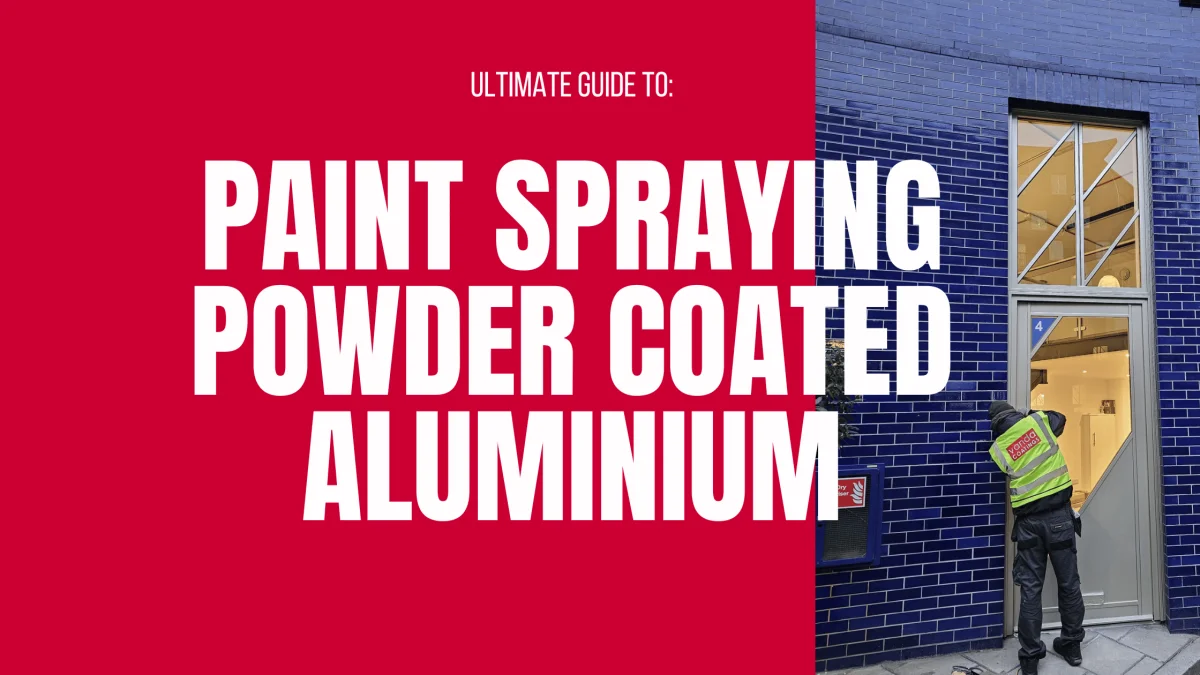
Powder coating has been the factory-applied finish of choice for commercial aluminium metalwork for over four decades. The process applies a fine powder of pigment and resin onto the aluminium surface; the coated item is then heated in a large oven, melting the powder into an even, durable coating that resists chipping, scratching, and the full range of UK weather conditions.
The result is a hard, attractive finish that performs extremely well for 15–25 years under normal commercial conditions. But eventually all powder-coated aluminium fades, chalks, or fails, and when it does, building owners face a decision. Replace the metalwork entirely, or recoat it on site?
For the majority of commercial installations where the substrate is structurally sound, on-site spray recoating is the right answer. This guide explains why powder coatings fail, how the on-site recoating process works, which coating systems to specify, and how to make the replacement versus recoating decision correctly.
Powder coating is an industrial finishing process that applies a protective and decorative finish to metal surfaces, predominantly aluminium and steel. The technique involves spraying a fine powder of pigment and thermosetting resin onto the metal substrate using an electrostatic gun. The charged powder adheres to the metal and the coated item is then passed through a curing oven at temperatures typically between 180°C and 200°C. The heat melts and chemically cross-links the powder, forming a continuous film that is significantly harder and more durable than conventional liquid paint.
For architects and specifiers, powder coating offers a consistent, highly controllable finish with a wide range of colour options (the full RAL Classic range is typically available as standard), various gloss levels, and textured surface options. For building owners, it provides a low-maintenance, corrosion-resistant surface that retains its appearance well over time. It is also an efficient process from a manufacturing standpoint, overspray can be collected and reused, making it more material-efficient than liquid paint.
The limitation of powder coating is that it requires a factory environment with large curing ovens. It cannot be applied in the field, on the building, or to installed metalwork. When the original factory coating reaches the end of its service life, the only options are removal and replacement of the metalwork, or on-site liquid painting over the existing powder coat.
Powder coating can fade as it ages due to sunlight and environmental factors. The sun emits UV radiation that gradually breaks down the pigments in the coating, causing them to lose their colour intensity. This process, called chalking, produces a powdery residue on the surface as the binder degrades and releases the pigment particles. Darker colours and colours with certain pigment bases tend to be more susceptible to fade than neutral or lighter tones.
The rate of fade depends significantly on:
Fade is the most common reason for recoating, but powder coating can fail in other ways too, and understanding the failure mode helps determine the correct remediation approach:
The most common cause of premature powder coat failure is inadequate surface preparation during manufacture. If the aluminium was not properly cleaned, degreased, and pre-treated before coating, the powder coat will not achieve full adhesion to the substrate. Failures of this type typically present as blistering, delamination, or peeling, often starting at cut edges, drilled holes, or other areas where the pre-treatment film is thinnest. These failures can appear within a few years of installation, well before UV degradation would be expected.
Incorrect powder application technique, excessive film build, uneven coverage, or contamination of the powder in the spray booth, creates defects that only become apparent during weathering. Pinholes in the film allow moisture to reach the substrate; excessive film thickness creates internal stresses that cause the coating to crack under thermal cycling. These defects are often not visible at installation but accelerate weathering failure.
Exposure to extreme temperatures, moisture, UV radiation, and atmospheric chemicals degrades the powder coating over time even when the original application was perfect. Acid rain, industrial pollution, and salt air (in coastal areas) are the most aggressive environmental factors. The rate of degradation is cumulative, surfaces that have been poorly maintained over many years typically show much worse condition than those that have been cleaned regularly.
Impact, abrasion, or scratching from building maintenance activities, cleaning with abrasive materials, or accidental damage compromises the powder coat locally. Once the film is broken, moisture can penetrate to the substrate, creating corrosion that then spreads beneath the surrounding coating and causes progressive delamination.
On-site spray painting of powder-coated aluminium is a service that allows trained professionals to prepare, treat, and apply liquid coatings using airless spraying techniques to previously powder-coated surfaces. The specialist coatings used add a protective barrier and restore the surface appearance to a standard that closely replicates the original factory finish.
The process involves six clearly defined stages:
Remove all dirt, grease, atmospheric deposits, and biological growth using an appropriate metal cleaner and water. For heavily soiled installations, a soft-brush clean followed by a low-pressure rinse is effective. Allow to dry completely, any residual moisture beneath masking tape or primer will cause adhesion failure. Pay particular attention to recesses, joints, glazing rebates, and fastener zones where deposits accumulate and are hardest to see.
Identify and address any areas where the aluminium substrate has corroded beneath the existing powder coat. Mechanically strip corrosion deposits using nylon abrasive pads or power sanders, working carefully to avoid damaging sound surrounding areas. Wipe down with tack cloths after mechanical treatment to remove all loose particles and abrasion debris. Areas of significant corrosion may require a dedicated etch primer to stabilise the substrate before the main primer coat is applied.
Sand or abrade the substrate to remove the gloss from the existing powder coating and create a surface key for the new coating to adhere to. This step is essential, attempting to apply a new coating directly to a gloss powder coat surface without abrasion will result in poor adhesion and premature failure, regardless of the quality of the coating system used. Use a suitable abrasive paper or nylon pad equivalent to P240–P320 grit. Work systematically across all faces and edges. Remove abrading dust with tack cloths before proceeding.
Protect all glazing, surrounding building fabric, and adjacent surfaces from overspray using plastic sheeting, decorator tape, and masking paper. On commercial buildings with multiple window or door units, systematic masking takes significant time, but it is a critical step. Overspray on glass is extremely difficult to remove cleanly; overspray on brickwork, render, or UPVC is often impossible to remove without damage. Thorough masking is what distinguishes professional on-site spraying from amateur application.
Apply an aluminium-compatible primer immediately after cleaning, ensuring the primer selected is confirmed compatible with the alloy grade and with the topcoat system to be used. On areas of exposed bare aluminium, where the original powder coat has been removed or has completely delaminated, an etch primer should be applied first to provide adhesion to the bare metal substrate before the main primer coat. Allow the primer to cure to the manufacturer's specified minimum overcoat time before applying the topcoat.
Select a two-pack acrylic topcoat in the appropriate colour and gloss level, confirming compatibility with the primer system. Apply by airless spray in two thin coats, allowing adequate flash-off time between coats as specified in the product data sheet. Two thin coats produce a more uniform finish and better adhesion than a single thick coat. Apply the first coat in a consistent direction; apply the second coat perpendicular to the first to achieve even film coverage across profiled surfaces. Allow full cure before de-masking and returning the building to occupation.
The coating system specified for on-site recoating of powder-coated aluminium is arguably the most important decision in the entire project. Professional contractors use commercial-grade coatings that are harder wearing than DIY products and specifically designed to protect against the UK climate. Most include warranty periods.
At Vanda Coatings, we use two-pack acrylic coatings proven in their application on commercial aluminium substrates. Two-pack acrylics are chemically cured, the two components react on mixing to form a hard, cross-linked polymer film that is significantly more durable than single-pack alternatives. Key properties of 2K acrylics in this application include:
One of the practical advantages of on-site liquid recoating over factory powder coating is the breadth of the available colour palette. Most powder-coated aluminium windows and doors are installed in a RAL or British Standard colour. When recoating with a 2K acrylic system, the same colour can be matched, or any other colour can be specified instead.
Most commercial 2K acrylic topcoat manufacturers offer colour matching from the full RAL Classic range, RAL Design system, NCS, and British Standard 4800. Some suppliers have access to databases of over any RAL, NCS, or British Standard colour, with spectrophotometric matching for bespoke shades including Pantone references. Colour matching from a physical sample or swatch is also possible, which is particularly useful when matching historic or bespoke colours that may not have a current RAL or BS reference.
Colour change is often the trigger for recoating. Many of our commercial clients use a scheduled recoating project as the opportunity to update the building's appearance, a colour change from an outdated shade to something more contemporary. Done at the same time as necessary maintenance work, this adds significant value to the project without a proportionate increase in cost.
The most common application, commercial curtain wall frames, casement windows, tilt-and-turn units, and entrance doors.
Retail and commercial shopfront systems, typically aluminium box section framing with integral glazing and door units.
Aluminium rainwater goods and architectural trim elements, often overlooked but visible and subject to the same fading as window frames.
Commercial roller shutter door curtains and associated frames, typically galvanised steel with powder coat, recoatable with correct primer selection.
Commercial and residential lift door facings, powder-coated steel that can be recoated in situ without lift shaft access requirements.
Structural steel and aluminium staircases in commercial interiors, balustrading, handrails, and stringer sections.
Vanda Coatings has been providing on-site spray painting of powder-coated aluminium since our founding in 1997. We were among the first companies in the UK to offer this service commercially, originally recoating forecourt shop fronts before expanding across the full range of commercial aluminium installations we serve today. In that time we have recoated thousands of projects involving powder-coated aluminium objects across mainland Britain.
Key reasons our clients specify Vanda Coatings for this work:
Adhesion failure is almost always caused by inadequate preparation, not inferior coating. The most common failure mode on on-site recoating projects carried out by inexperienced contractors is premature delamination of the new coating, typically within 1–3 years. The cause is almost invariably inadequate mechanical abrasion of the existing powder coat before priming. When assessing quotations for this work, verify that the preparation process includes thorough mechanical abrasion of the existing surface as a documented step, if it does not, the risk of early failure is significant.
Yes, powder-coated aluminium windows, doors, shopfronts, and other architectural metalwork can be successfully recoated on site by trained professionals using airless spray application. The key requirements are thorough surface preparation including cleaning, mechanical abrasion to remove the gloss from the existing powder coat, application of a compatible aluminium primer, and then a two-pack acrylic topcoat. When the process is carried out correctly, the result closely replicates the appearance of the original powder coating and provides a service life of 10 or more years.
Powder coating fades primarily due to UV radiation breaking down the pigments in the coating over time. Environmental factors, moisture, heat, atmospheric pollutants, acid rain, and salt in coastal locations, accelerate degradation. Poor application during manufacture creates defects that only become apparent during weathering. Mechanical damage from impact or abrasive cleaning compromises the film locally and allows moisture ingress that spreads beneath the surrounding coating.
The preparation process involves: thorough cleaning to remove all contamination; mechanical removal of any corrosion; abrasion of the entire surface to remove the gloss from the existing powder coat and create a key for the primer; masking all adjacent surfaces; application of a compatible aluminium primer; and then spray application of the 2K acrylic topcoat in two thin coats. The abrasion step is the most critical, without it, the new coating will not achieve adequate adhesion.
On-site recoating is almost always significantly cheaper than replacement, typically by a factor of 3 to 5 times for standard commercial installations. Replacement involves the cost of new units, removal and disposal of the old installation, and reinstallation, plus potential complications during the removal phase. Recoating requires only access equipment, preparation, and coating application. For aluminium windows, shopfronts, and cladding where the substrate is structurally sound, recoating is the preferred option.
When recoating with a 2K acrylic system, virtually any colour can be specified. Most commercial coating manufacturers offer the full RAL Classic range, RAL Design, NCS, and British Standard colour matching. Some suppliers have access to databases of over any RAL, NCS, or British Standard colour, with spectrophotometric matching for bespoke shades including Pantone references. The existing colour can be matched exactly, or the building can be updated to any other colour. Recoating is an economical way to refresh or rebrand a building's appearance.
A correctly specified and applied on-site recoating system on powder-coated aluminium, using a compatible bonding primer and 2K acrylic topcoat, typically provides a service life of 10 or more years. The actual duration depends on the building's location and orientation, the quality of the coating system, and whether regular cleaning maintenance is carried out. Some systems carry manufacturer warranties of up to 10 years when applied to the specified film thickness and coverage rates.

Related articles on aluminium recoating and commercial surface finishing.
Our on-site aluminium window recoating service, full preparation, etch priming, 2K acrylic topcoat applied by airless spray, with a 10-year guarantee.
View ServiceHow to recoat PVF2 and PVDF fluorocarbon cladding correctly, covering the unique preparation challenges, primer selection, and coating compatibility.
Read ArticleWhat 2K acrylic paint is, how the chemistry works, and why it is the standard coating system for on-site recoating of commercial metalwork.
Read ArticleVanda Coatings understands the complexities of painting over existing powder-coated surfaces. Our trained professionals can recoat most powder-coated objects on site. Contact us for a free survey and written quotation.