Gloss Levels for Aluminium Windows
How matt, satin, semi-gloss, and gloss finish levels affect the appearance and durability of 2K acrylic coating systems on aluminium window frames and curtain walling.
Read ArticleA refreshed aluminium exterior transforms commercial premises and adds real value, without the disruption and cost of replacement. This guide covers everything: when recoating makes sense, what preparation the substrate needs, how colour selection works, the step-by-step process, and who benefits most from on-site aluminium spray painting.
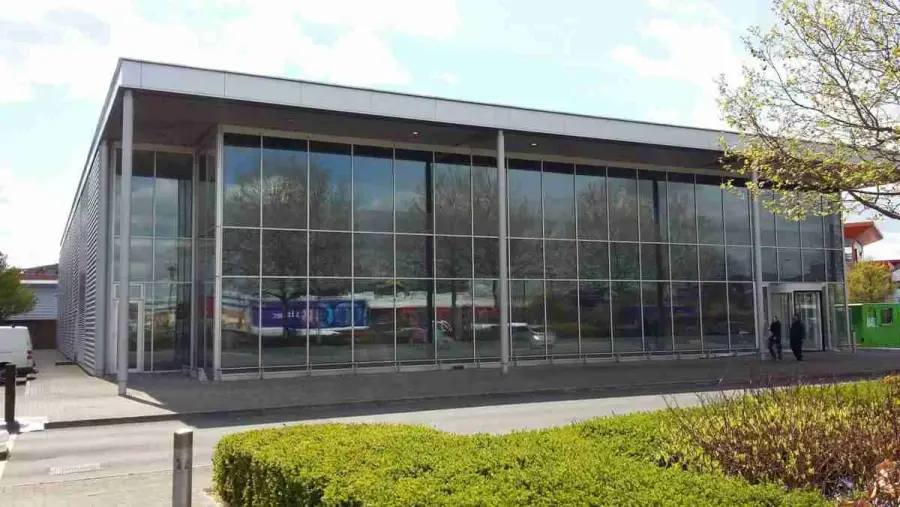
Spray painting aluminium on-site is one of the most cost effective ways to modernise a commercial building without the expense and disruption of full component replacement. Whether you are dealing with faded shopfront frames, oxidised window systems, discoloured curtain walling, or roller shutters that no longer match current brand colours, professional on-site recoating delivers a durable, factory-quality result in a fraction of the time and at a fraction of the cost of new units. Our aluminium window spraying service covers exactly this kind of on-site refresh.
We have been spraying aluminium on commercial sites for over 29 years, from single shopfronts to multi-storey curtain walling programmes on city centre office blocks. The process works. But it only works well when you get the preparation, coating system, and equipment right.
Yes, and it is done commercially every day. Aluminium is a highly versatile substrate that accepts high-performance coating systems when properly prepared. Both powder-coated aluminium and anodised aluminium can be recoated in situ without removing the frames, shutters, or panels from the building. Interior and exterior faces can be coated in the same colour or specified differently, depending on the project requirement.
The caveat is preparation. Aluminium is non-porous and naturally resists adhesion. Paint applied to unprepared or poorly prepared aluminium will peel, blister, or delaminate, sometimes within months. Preparation is not optional. It is what separates a result that lasts a decade from a cosmetic fix that fails in the first year.
Save money and time by refurbishing your aluminium on-site instead of replacing it. On-site recoating typically costs 20–30% of the equivalent replacement cost, produces zero waste from component disposal, and avoids the security risk and business disruption of open frames during new unit installation.
We work with a broad mix of clients across commercial and retail sectors. What they all have in common is existing aluminium that needs to look better, without the cost and disruption of ripping it out.
Refreshing building exteriors to maintain lettable value, update brand alignment, or address weathering and oxidation on window systems, entrances, and facades before a new tenancy or sale.
Colour-changing shopfront frames, fascias, and entrance details to align with rebrand programmes, a fraction of the cost and lead time of procuring and fitting new shopfront systems.
Bringing specialist recoating capability into larger refurbishment or maintenance programmes where the general contractor needs a reliable, experienced subcontract spraying resource on-site.
Specifying recoating as a sustainable, lower-embodied-carbon alternative to aluminium replacement on refurbishment projects where the existing substrate is structurally sound.
Maintaining the appearance of managed portfolios, window systems, curtain walling, entrances, shutters, through planned recoating cycles that extend asset life and defer capital replacement spend.
Where planning or listed building consent prevents replacement of existing aluminium components, on-site recoating is often the only permitted route to improving appearance and protecting the substrate.
Not every aluminium substrate is a recoating candidate, but most are. The following situations commonly prompt a recoating enquiry:
On-site spray painting is applicable to the full range of architectural aluminium, whether the current surface is bare, powder-coated, hand-painted, oxidised, or anodised. The preparation method varies by substrate type, but the process is viable across all of them.
This is the most common substrate encountered on commercial premises built from the 1980s onwards. Powder-coated aluminium that is in good overall condition, sound, not delaminating, without significant physical damage to the substrate, can be recoated with relatively straightforward preparation. Old, chalky, or heavily UV-degraded powder coatings require more intensive abrasion to ensure the new coating bonds to a stable base rather than to a degraded surface layer.
Anodised aluminium is harder to recoat than powder-coated. The anodised layer is extremely dense and resists adhesion; it must be mechanically abraded to key the surface before any primer or topcoat is applied. Light sanding alone is typically insufficient, abrasive pads or specialist abrasive media are required to achieve the surface profile necessary for reliable adhesion. When prepared correctly, anodised aluminium recoats durably and the results are long-lasting.
Bare aluminium and aluminium previously painted with brush-applied systems require thorough degreasing, mechanical abrasion, and etch priming before topcoat application. The natural oxide layer on bare aluminium is the adhesion barrier that must be broken through during preparation, etch primer provides the chemical bond between the substrate and the coating system.
Interior and exterior faces can be specified in different colours. A common commercial application is matching exterior frames to a new facade colour whilst keeping interior faces white or a neutral specification. Office furniture, internal partitions, and other aluminium architectural features are also candidates for on-site recoating.
Colour choice matters more than most clients expect. The coating systems we use give access to a far broader range of precisely specified colours than anything you will find on a hardware supplier's shelf.
The most widely used colour system for architectural metalwork in the UK and Europe. RAL Classic provides 213 standardised colours; RAL Design covers over 1,600 colours across the full spectrum. All RAL references can be specified by number and matched precisely from stock or manufactured to order.
British Standard colour references are frequently specified on local authority, public sector, and heritage refurbishment projects. BS 4800 covers 100 colours used widely in the construction and building sectors. All BS references are available in the coating systems used for on-site aluminium spraying.
Where a bespoke, proprietary, or unidentified existing colour needs to be replicated, laboratory spectrophotometric matching measures the existing surface and formulates an exact match. This is particularly useful for matching extensions to existing buildings or aligning new work with existing, unknown-reference finishes.
Black (RAL 9005), Pure White (RAL 9010), Traffic White (RAL 9016), Anthracite Grey (RAL 7016), Window Grey (RAL 7040), and Signal White (RAL 9003) are the most frequently specified colours for commercial aluminium window, door, and shopfront programmes.
Recoat or replace is a commercial decision. If the substrate is structurally sound, recoating is almost always the right answer. Here is how the two options compare.
| Factor | On-site recoating | Full replacement |
|---|---|---|
| Typical cost | 20–30% of replacement cost | Full component and installation cost |
| Disruption | Minimal, building remains occupied, frames in place | Significant, open frames, weather exposure, security risk |
| Lead time | Days to weeks depending on scale | Weeks to months for manufacture and install |
| Colour choice | thousands of colours, any RAL or BS reference | Standard range, custom colours at extra cost and lead time |
| Waste & carbon | Zero substrate waste, existing aluminium retained | Disposal of existing units; embodied carbon of new manufacture |
| Structural requirement | Substrate must be structurally sound, recoating is cosmetic | New structure, no dependency on existing substrate condition |
| Listed building compatibility | Generally permitted without consent | Replacement may require listed building or planning consent |
| Result | Factory-quality durable finish, 10-year guarantee available | New units with manufacturer warranty |
Thorough masking is non-negotiable on occupied commercial sites. Airless spray application of coatings produces overspray, fine atomised particles that travel beyond the intended surface. On commercial premises with glazing, brickwork, signage, parked vehicles, and pedestrian areas nearby, every adjacent surface must be masked before spraying begins. Insufficient masking is the most common cause of third-party damage claims and complaints on spray painting projects. Professional contractors carry out masking as a primary part of site preparation, not an afterthought.
The quality of any on-site aluminium recoat comes down to preparation. Spraying is the fast part. A professional crew will typically spend more time preparing the surface than coating it. When you spray your aluminium windows on site with an experienced team, that preparation discipline is what delivers a finish that lasts.
The client selects the desired finish colour using RAL, British Standard, or a spectrophotometric match of an existing colour. The coating system, primer type, topcoat chemistry, gloss level, and number of coats, is specified to match the substrate condition, exposure environment, and durability requirements. For exterior aluminium on occupied commercial premises, a two-pack acrylic polyurethane system is the standard professional specification.
All adjacent surfaces, glazing, brickwork, signage, ironmongery, thresholds, and any other components not being recoated, are masked and covered before any preparation or coating work begins. On commercial sites this typically includes covering large areas of glazing with polythene sheeting, masking tape to glass edge lines, and placing drop sheets on floors and pavements. Containment of overspray and preparation debris is a critical part of professional site management.
The aluminium is cleaned using a mild solvent solution or specialist cleaning agent to remove surface grease, oil, dirt, pollution deposits, and any loose or friable material. Contaminated surfaces dramatically reduce the adhesion effectiveness of both the etch primer and topcoat. This stage must not be rushed, invisible contamination from handling, traffic pollution, or building maintenance products is the most common hidden adhesion risk on exterior aluminium.
The substrate surface is abraded to remove loose or degraded coating, to break the natural oxide layer on bare or anodised aluminium, and to create a surface profile that promotes mechanical adhesion of the primer. The intensity of preparation varies by substrate: new or sound powder-coated aluminium requires light abrasion; old chalky powder coatings require more aggressive abrading; anodised aluminium requires the most intensive mechanical preparation to break through the dense anodised layer. Any physical damage, dents, deep scratches, pits, is filled and feathered at this stage.
An etch primer is applied to the prepared aluminium. Etch primer chemically bonds to the metal substrate and provides the stable bonding layer to which the topcoat adheres. This is the most critical step in the entire process, omitting it or applying it incorrectly is the primary cause of premature recoating failure on aluminium. The etch primer must be applied to a clean, freshly prepared surface and allowed to reach the correct dry film thickness before topcoat application proceeds.
The topcoat is applied by airless or electrostatic spray in the client-specified colour, typically in two passes to achieve the required dry film thickness. Electrostatic spraying is particularly effective on complex aluminium profiles, the electrostatic charge causes the atomised coating to wrap around edges and into recesses that a conventional airless pass would miss. Coatings are applied by trained operatives with experience of working at height on commercial sites, including MEWP and ladder work for multi-storey applications. Fast-drying systems allow second coats to be applied the same day; the building can typically return to normal operation within hours.
Once the topcoat has reached sufficient cure to handle, all masking materials are carefully removed. The completed work is inspected by the operative and supervisor for coverage, film build, colour consistency, and finish quality. Any minor deficiencies, small holidays, thin areas at rebates or corners, are addressed before sign-off. The client receives a clean site with no masking residue, no overspray, and refreshed aluminium that looks factory-finished.
At Vanda Coatings, all exterior aluminium recoating projects use a two-pack acrylic polyurethane topcoat system applied over a specialist etch primer. Two-pack acrylics cure by chemical cross-linking rather than simple solvent evaporation, the result is a harder, more chemically resistant film with significantly better UV stability and durability than single-component systems. This is the same coating chemistry used in factory powder-coating application, applied on-site using professional-grade airless and electrostatic equipment.
Finish sheen level is a separate specification decision from colour. The same RAL colour can be specified across a range of gloss levels depending on the aesthetic requirement and the performance environment.
Gloss level is specified by Gloss Units (GU) measured at 60°. The product data sheet for the selected coating system will confirm the available gloss range and the measurement method. If in doubt, request a sample panel in the specified colour and gloss level before full project commencement.
Project timescales vary considerably with scope and substrate condition. The guide below gives a practical indication of what to expect:
On occupied commercial premises, work is routinely carried out outside trading hours, evenings, nights, and weekends, to minimise disruption. The new coating is dry to the touch within hours; building occupants can return to normal use very quickly after each day's work is complete. If you're ready to move forward, request an aluminium window spraying quote and we'll specify the right coating system for your site.
Yes. On-site aluminium spray painting is carried out with all frames, shutters, and panels fully installed. No removal is necessary. The preparation, masking, priming, and topcoating are all carried out in situ, which is precisely why it costs so much less than replacement and causes so much less disruption. Work is carried out on shopfronts, window systems, curtain walling, doors, fascias, and roller shutters, all while the building remains occupied and operational.
Access to more than any RAL, NCS, or British Standard colour, with spectrophotometric matching for bespoke shades is available through specialist coating suppliers using RAL Classic, RAL Design, British Standard, and spectrophotometric colour matching systems. Any RAL or BS reference can be matched precisely. Laboratory spectrophotometric matching is available for bespoke or proprietary shades. Common commercial choices include RAL 9005 Jet Black, RAL 9010 Pure White, RAL 7016 Anthracite Grey, and RAL 9016 Traffic White. Interior and exterior faces of the same frame or shutter can be specified in different colours.
Yes, an etch primer is essential and must not be omitted. Aluminium is non-porous and naturally resists adhesion. Without an etch primer, the topcoat has no stable chemical bond to the substrate and will delaminate, typically at the first opportunity the coating system is exposed to UV, thermal movement, or moisture. Etch primer is applied after surface preparation and before any topcoat pass. It is the single most important step in achieving a durable, long-lasting result on aluminium.
A single shopfront or entrance framework can typically be recoated in one to two days. Larger projects, office blocks with extensive curtain walling or multi site retail programmes, are planned in phases, with work carried out day or night and at weekends to minimise disruption to building occupants and traders. The new coating is dry to the touch within hours of application; full cure takes longer depending on the specific coating system and ambient temperature and humidity conditions.
Replacement removes the existing components entirely and installs new ones, a major disruptive operation with significant cost, waste, and security risk during the open-frame period. Recoating restores appearance and extends service life in place, at 20–30% of replacement cost, with minimal disruption. Where the aluminium substrate is structurally sound, recoating is almost always the more cost effective and environmentally responsible choice. The exception is where frames have structural or seal integrity issues, recoating is a cosmetic process and cannot resolve those problems.
Yes, anodised aluminium can be professionally recoated, but it requires the most intensive preparation of any aluminium substrate. The anodised layer is extremely hard and dense; light sanding alone is insufficient to key the surface for reliable adhesion. Abrasive pads or specialist abrasive media are used to mechanically break through the anodised layer before etch primer application. When prepared correctly, the recoated finish on anodised aluminium is durable, long-lasting, and visually indistinguishable from a factory-applied powder coat.

Related articles on aluminium recoating and on-site spraying.
How matt, satin, semi-gloss, and gloss finish levels affect the appearance and durability of 2K acrylic coating systems on aluminium window frames and curtain walling.
Read ArticleWhat 2K acrylic paint is, how the chemistry works, and why it is the standard high-performance coating system applied to commercial aluminium on-site.
Read ArticleOur on-site aluminium window recoating service, full preparation, etch priming, two-pack acrylic topcoat in any RAL colour, and a 10-year guarantee.
View ServiceFree site surveys and quotes for on-site aluminium spray painting projects across the UK. Tell us your surface type, location, and colour requirement and we'll specify the right coating system and give you a clear, no-obligation price.