Recoating Lift Doors: Liverpool Case Study
How we recoated lift doors in a live Liverpool office block using electrostatic spraying, multiple colours, occupied building, overnight schedule.
Read Case StudyLift landing doors take more daily contact than almost any other surface in a commercial building. When the finish becomes scratched, discoloured, or worn, on-site electrostatic spray painting restores them to a factory-quality finish, overnight, without taking the lift out of service.
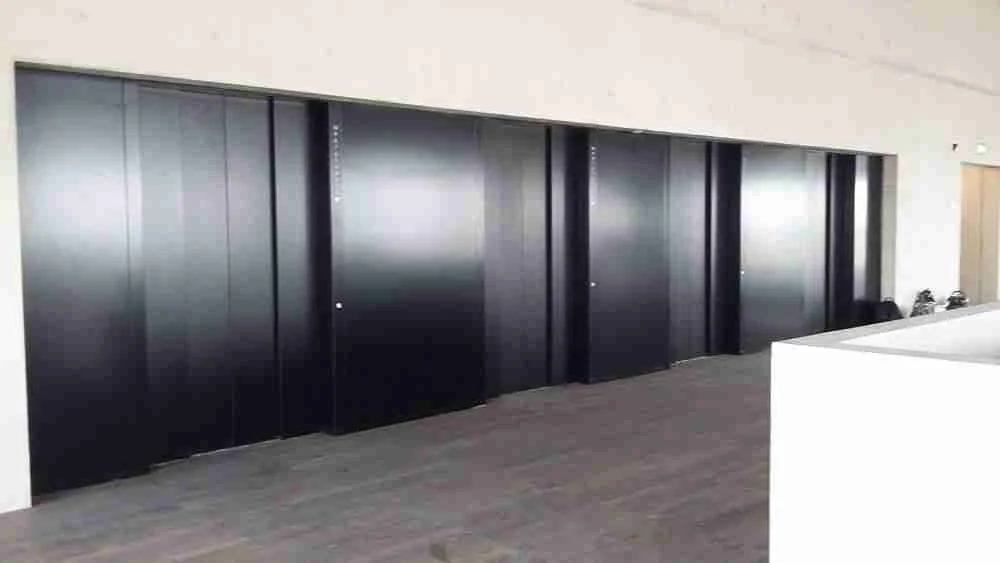
Lift doors are one of the most visible and most-touched surfaces in any office block, hotel, hospital, or shopping centre. Scratches accumulate from trolleys and luggage. Scuff marks build around door edges from daily foot traffic. Painted or powder-coated finishes fade unevenly under harsh lobby lighting. And yet the lift itself may be in perfect mechanical order, replacing doors to address a cosmetic problem is an expensive, disruptive, and entirely unnecessary response.
On-site electrostatic spray painting is the practical alternative. It restores the surface to a consistent, durable finish in a single overnight session, at a fraction of the cost of door replacement, with no structural work and no extended lift downtime.
Lift landing doors face a combination of mechanical abrasion and environmental stress that accelerates finish degradation. The door edges and frames are struck repeatedly by trolleys, cases, and hand trucks during loading. Door faces are touched thousands of times a day by people steadying themselves as doors open and close. In environments with high foot traffic, hospitals, hotel corridors, supermarket back-of-house, the finish can show visible wear within two to three years of installation.
In buildings where the interior has been refurbished, original lift door colours also frequently fall out of step with new wall finishes, floor coverings, and reception schemes. A fresh colour is often needed not because the surface is damaged, but because the scheme has moved on.
Both situations, wear-driven degradation and aesthetic mismatch, are addressed effectively by on-site electrostatic recoating.
Electrostatic spraying works by electrically charging the atomised paint particles as they leave the spray gun. The lift door panels, which are earthed metal, attract the charged particles, causing them to wrap around edges and profiles rather than bouncing off or drifting away as overspray. This produces several important advantages in a lift lobby environment:
For situations where electrostatic equipment is less suitable, such as very deep recesses within the door frame, or lift car interior panels with complex profiles, HVLP (high volume low pressure) spraying can be used as a complement. Both methods produce a factory-quality finish when applied correctly to a properly prepared surface.
Every lift door recoating project follows the same methodical sequence. Shortcuts at any stage compromise the final finish, particularly in the preparation phase, where the quality of the cure adhesion is established before any topcoat is applied.
The lift lobby is cordoned off using barriers, cones, and advisory signage before any work begins. Building management and security are notified. Where multiple lifts serve the same floor, adjacent lifts remain in operation so the building does not lose vertical access. The operative confirms ventilation arrangements for the lobby, particularly important in enclosed basement or basement-adjacent lobbies.
Polythene sheeting is taped to adjacent wall surfaces, skirting boards, and floor coverings. Button consoles and call panels are masked individually with masking paper and tape to protect the mechanism housing and any glazed or printed face panels. Door threshold strips and floor sensors are also masked where present. Thorough masking at this stage is the single most important factor in preventing contamination of surrounding finishes.
The door faces, edges, frames, and any side panels are cleaned thoroughly to remove grease, traffic film, and any loose or flaking existing coating. Dents, scratches, and surface damage are filled and abraded to a smooth profile. Any corrosion is treated and the affected area primed locally. A light mechanical abrade across the full surface creates the mechanical key needed for primer adhesion. At this stage, any graffiti, adhesive residue, or heavy soiling is also addressed.
A primer coat is applied to the prepared surface. The primer system is selected to suit the existing substrate, bare steel, existing paint, or powder coat, and the specified topcoat. On steel surfaces with any corrosion history, a corrosion-inhibiting primer is used. The primer is allowed to flash off fully before the topcoat application begins.
The colour topcoat is applied electrostatically in two thin coats, allowing adequate flash-off time between passes. The coating system used is a two-pack acrylic formulation, a hard-wearing, chemically resistant finish suited to the abrasion and contact demands of lift door use. Any colour from the RAL, BS, or NCS range can be mixed and matched, including metallic finishes that replicate the appearance of steel, brushed aluminium, brass, or copper.
Once the topcoat has been applied and the initial cure time observed, all masking materials are carefully removed and the lobby is inspected for any overspray, edge bleed, or areas requiring touch-in. The lobby is left clean and presentable before the team departs. Overnight drying means the coating reaches handling strength by the following morning, ready for normal lift use.
For building managers evaluating options, the comparison between on-site recoating and full door replacement is straightforward on cost and disruption grounds. The table below sets out the key factors.
| Factor | On-site electrostatic recoating | Full door replacement |
|---|---|---|
| Relative cost | Small fraction of replacement cost | High, new panels, frames, and engineering labour |
| Lift downtime | Overnight only, in service by morning | Days to weeks depending on lead time for panels |
| Colour options | Any RAL / BS / NCS colour, including metallics | Dependent on manufacturer's standard options |
| Structural works required | None | Yes, lift engineer required for installation |
| Finish quality | Factory-quality uniform finish | Factory finish on new panels |
| Suitability | Cosmetic wear, colour change, scratch repair | Structural damage or mechanical failure only |
Electrostatic spraying is applicable to virtually all metal components associated with lift landing installations. In most recoating projects, the scope includes:
Glass inserts within door panels, button console face plates, and any digital display panels are masked off and not sprayed. Stainless steel lift doors with brushed or mirror finishes require a different assessment, where the existing stainless surface is in good condition, a metallic effect coating over it is an option; where genuine stainless panels are required, replacement is the correct route.
Planning your project? Vanda Coatings provides free site surveys for lift door recoating projects across the UK. We assess the existing finish condition, discuss your colour requirements, and provide a fixed written quotation covering all preparation, priming, topcoating, and de-masking. Most projects are completed without any additional day-rate variations, what we quote is what you pay.
One of the most common reasons building managers commission lift door recoating is to update the colour to match a refurbished interior. Lift lobbies that were last decorated in the 1990s or early 2000s frequently carry door finishes in colours, beige, oatmeal, pale grey, that look dated against modern interior schemes.
Any colour from the RAL Classic, RAL Design, British Standard 4800, or NCS range can be mixed and applied. Where a building has a specific corporate or brand colour, paint manufacturers can mix to a supplied colour reference or from a physical sample. Metallic topcoats, replicating the appearance of brushed steel, satin aluminium, antique bronze, or aged brass, are also available and are applied in the same electrostatic process.
Where a colour match to an existing adjacent surface is required, a paint chip or physical sample allows the correct BS or RAL reference to be identified before spraying begins.
The majority of lift door recoating projects take place in occupied commercial buildings, office blocks, hotels, hospitals, and residential apartment buildings where the lift serves active floors 24 hours a day. Electrostatic spraying is well suited to this environment because:
Where access restrictions or building management requirements make even brief overnight cordoning impractical, we discuss scheduling options with the client to identify a window, weekend, bank holiday, or annual shutdown period, when the work can proceed without inconvenience to occupants.
Electrostatic spraying is the preferred method for lift doors because it produces minimal overspray, which is critical in occupied commercial environments. The electrically charged paint particles are attracted to the earthed metal surface, wrapping around edges and profiles to give a uniform, even finish. This reduces the risk of paint contaminating nearby button consoles, flooring, and wall surfaces, even when working in confined lobbies.
Yes. Work is carried out on the external landing doors only, which means the lift car itself remains operational between sessions. In most cases, spraying is completed out of hours, evenings or weekends, with the coating dry and ready for use by the following morning. The lift lobby is cordoned off during application and the masking removed before the building opens, resulting in minimal operational disruption.
A typical single lift landing door installation, including masking, preparation, priming, and two top coats, takes approximately three to five hours per floor. For a multi floor building, operatives work floor by floor through the night, leaving each floor complete before moving to the next. Overnight drying means doors are ready for use the following morning.
Any RAL, British Standard, or NCS colour can be matched and applied. Metallic finishes, including steel effect, brushed aluminium, bronze, and brass appearance, are also achievable using specialist metallic topcoats. This allows a building manager to update lift door aesthetics to match a refurbished interior colour scheme without any structural changes to the door installation.
Significantly cheaper. Lift door replacement requires specialist lift engineers, new door panels and frames, and extended lift downtime, often days to weeks depending on panel availability. On-site electrostatic recoating typically costs a small fraction of replacement cost, produces a factory-quality finish, and can be completed overnight with no structural works involved.
Electrostatic spraying is suitable for all standard metal lift landing doors, including steel-panel doors, powder-coated frames, and metallic-finish door leaves. It covers landing door leaves, door frames, side panels, and header sections. Glass inserts are masked off. Where stainless steel panels carry a brushed or mirror finish in good condition, a metallic topcoat can be applied over the existing surface, though replacement is the appropriate route for genuinely damaged stainless panels.

Related articles on on-site metalwork spraying.
How we recoated lift doors in a live Liverpool office block using electrostatic spraying, multiple colours, occupied building, overnight schedule.
Read Case StudyOur on-site electrostatic painting service for commercial metalwork, lift doors, office partitions, radiators, and structural steelwork.
View ServiceHow airless spraying works, how it compares to electrostatic and HVLP methods, and why it is the standard for commercial surface coating.
Read ArticleSee It In Practice
See how we recoated 36 lift door faces across a live occupied office building, staged to avoid disruption to building occupants.
View Case StudyFree site surveys and fixed-price quotes for lift door recoating across the UK. Tell us your building location, the number of floors, and your colour requirements and we'll specify the correct coating system and schedule.