Acrylic Two-Pack Paint: The Complete Guide
What 2K acrylic paint is, how the chemistry works, and why it is the standard coating system applied by airless spray on commercial metalwork.
Read ArticleHow airless spraying works, how it differs from HVLP and brush application, its advantages and limitations, correct technique, and why it is the standard method for commercial metalwork and large-scale surface coating.
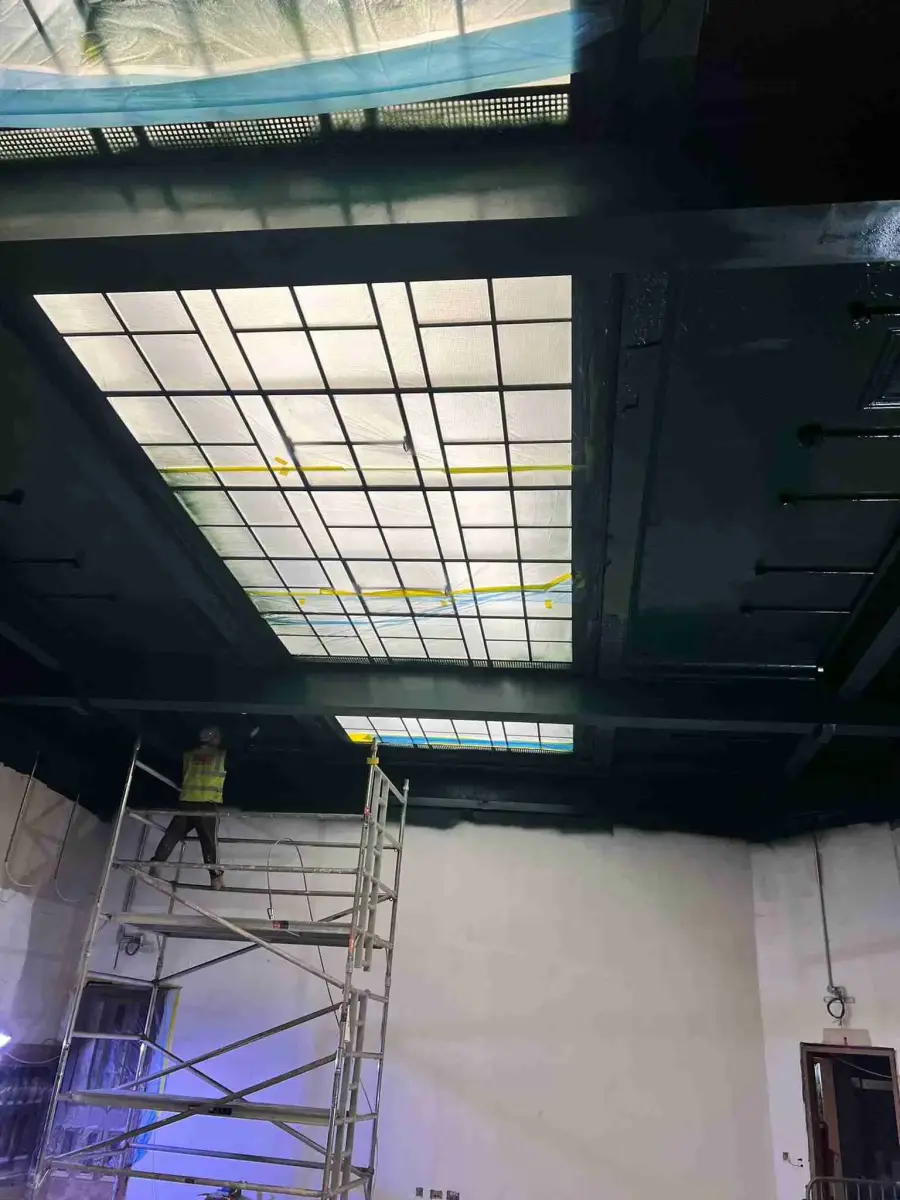
Airless paint spraying produces a consistently smooth, high-build coating finish that brushes and rollers cannot replicate on commercial metalwork. For large-scale or profiled surfaces, aluminium window frames, cladding systems, roller shutter doors, shopfronts, it is the only method that delivers the uniform film quality and application speed that commercial projects demand.
This guide explains how airless spraying works, what distinguishes it from other application methods, and what correct technique and safety practice look like in a commercial on-site context.
The defining characteristic of airless spraying is that it atomises paint using hydraulic pressure alone, no compressed air is mixed into the fluid. A high-pressure pump forces liquid coating through a hose and out through a very small nozzle tip at pressures typically ranging from 300 to 7,500 psi. As the pressurised fluid exits the tip into the atmosphere, the sudden pressure drop breaks it into fine droplets, a process called atomisation.
The tip shape determines the spray fan pattern width; the tip orifice diameter and the pump pressure together determine the flow rate and droplet size. This gives the operator direct control over coverage rate and film build by adjusting pressure and selecting the correct tip for the coating and surface.
High-pressure pump (electric, hydraulic, or pneumatic) forces paint at 300–7,500 psi
High-pressure hose delivers paint under pressure to the spray gun, typically 15–30m long on commercial rigs
Trigger releases paint through the nozzle tip; tip orifice size and shape control flow rate and fan pattern width
Pressure drop at tip atomises the liquid into fine droplets, a uniform fan pattern applied to the surface
The pump is the heart of the system, it draws paint from the supply container and pressurises it through the hose. Pumps are rated by output pressure (psi), flow rate (gallons per minute), and horsepower. Electric models use a motor linked to a piston via a crankshaft mechanism. The pump rating must be matched to the coating viscosity and project scale, an underpowered pump will struggle with thick coatings or long hose runs.
Designed to handle operating pressures up to 7,500 psi. Hose length affects pressure drop at the gun, longer hoses require marginally higher pump pressure to compensate. On commercial on-site projects, hose lengths of 15–30 metres are typical, allowing the pump unit to remain at ground level while the operative works at height. Hoses must be inspected regularly for damage, kinks, or wear.
The spray gun controls the trigger action and mounts the spray tip. A well-maintained gun should have a smooth, consistent trigger response. Guns must be fitted with a safety guard or trigger lock when not in active use, this is a critical safety requirement given the injection injury risk at these pressures. Regular cleaning prevents dried paint build-up in the fluid passages that would affect spray pattern quality.
The tip is the most frequently replaced component. Tip sizes are graded by orifice diameter, small tips suit thin coatings; larger tips handle thicker materials such as latex or high-build primers. Fan pattern width is also determined by tip geometry. Tungsten carbide tips offer the best abrasion resistance. A tip should be replaced when the spray pattern width has decreased by 25% from new, a worn tip produces heavier edges and uneven film build. Reversible tips allow quick clearing of blockages without removing the tip from the gun.
Three application methods are relevant for commercial metalwork: airless spraying, HVLP (high volume low pressure) spraying, and brush or roller application. Each has its place, but for large-scale commercial on-site work, airless is the standard choice.
| Factor | Airless spray | HVLP spray | Brush / roller |
|---|---|---|---|
| Atomisation method | Hydraulic pressure only | High-volume compressed air | Manual, no atomisation |
| Application speed | Very fast, 4× brush, 2× roller | Fast, quicker than brush | Slow, labour-intensive |
| Finish quality | Uniform, high-build, factory-quality | Very fine finish, less orange peel | Brush marks and roller texture visible |
| Film build per pass | High, fewer coats required | Moderate | Moderate, depends on technique |
| Overspray | 20–40%, requires thorough masking | 10–20%, less than airless | None |
| Suitability for thick coatings | Excellent, handles high-viscosity materials | Good, suits thinner coatings better | Good |
| Profiled/textured surfaces | Excellent, penetrates complex profiles | Very good | Difficult, uneven coverage on profiles |
| Transfer efficiency | 60–80% | 65–90%, most efficient spray method | Near 100% |
| On-site portability | Excellent | Good | Excellent |
| Best suited for | Large commercial projects, metalwork, cladding | Detailed work, furniture, interior finishing | Touch-ins, small areas, where spray is impractical |
Injection injury risk, treat with the same seriousness as a sharp instrument. Airless spray guns operate at pressures up to 7,500 psi. At these pressures, the fluid stream exiting the nozzle tip can penetrate skin and cause extremely serious injection injuries that require immediate surgical treatment. The nozzle must never be pointed at any part of the body. Pressure must be fully relieved, by triggering the gun into a waste container, before changing tips, cleaning the gun, or performing any maintenance. The trigger safety lock must be engaged whenever the gun is not in active use.
The quality of an airless-sprayed finish depends as much on technique as on equipment. Poor technique produces heavy edges, runs, uneven film build, and texture, all of which are avoidable with the correct approach.
Clean the screen and filters before use. Prime the pump by cycling it without the tip attached to fill the hose with paint and purge all air. Install the tip only once the hose is fully primed and no air bubbles are visible in the fluid. Set initial pressure at the lower end of the recommended range for the coating, increase only if atomisation is inadequate.
Maintain the gun at approximately 30cm (12 inches) from the surface throughout the stroke. Hold the gun perpendicular to the surface, tilting produces an uneven fan pattern with heavier deposition at one edge. Do not arc the wrist during the stroke; the gun should travel in a straight, consistent line parallel to the surface plane.
Begin each stroke by moving the gun before pulling the trigger, and release the trigger before the gun stops at the end of the stroke. This "lag stroke" technique prevents paint build-up at stroke start and end points, a common cause of runs and heavy edges. The trigger is active only during the central portion of the stroke across the target surface.
Overlap each pass by 30–50% of the fan width to produce an even, uniform film across the surface. Consistent overlap is critical, gaps produce thin areas; excess overlap produces heavy areas and potential runs. Move in straight horizontal lines; on vertical surfaces work top to bottom so any runs from wet edges are caught on the next pass.
Apply two or more thin coats rather than attempting to achieve the full dry film thickness in a single pass. Thick single coats are prone to runs, sags, and poor cure, particularly with 2K acrylic systems where the chemical cross-linking reaction requires consistent film thickness. Allow adequate flash-off time between coats as specified in the product data sheet.
On large flat areas, spray perimeter edges first to establish coverage at the extremities, then fill in the centre. On profiled metalwork (window frames, door frames), spray rebates and recesses first, then face surfaces, this ensures adequate coverage in the areas most prone to thin film. On small items such as door panels, spray edges vertically first, then apply horizontal passes across the face to produce an even, unified finish.
Flush the pump, hose, and gun thoroughly immediately after use, dried paint in the pump mechanism or hose is difficult to remove and damages components. For water-based coatings, flush with clean water followed by a gun cleaner. For solvent-borne coatings, flush with the appropriate solvent. Remove and clean the tip and filter separately. Relieve all pressure before disassembling any component.
The spray tip is the most wear-sensitive component in the system. Maintaining tips correctly extends their service life and preserves spray pattern quality:
At Vanda Coatings, our operatives use professional-grade airless spray equipment on every commercial project, matched to the specific coating system, surface type, and project scale. Equipment is calibrated and cleaned to manufacturer's specification before and after every project. All application is carried out by trained operatives with extensive experience in commercial on-site spraying across a full range of substrates and coating systems.
Airless paint spraying is a method of applying liquid coatings by forcing paint through a small nozzle tip at very high pressure, typically between 300 and 7,500 psi. The pressure atomises the liquid into a fine spray fan without mixing compressed air into the fluid stream. It produces an even, high-build film that is the standard finish for commercial metalwork, cladding, and large-scale surface coating projects.
Airless sprayers atomise paint purely through hydraulic pressure, no air enters the fluid stream. HVLP (High Volume Low Pressure) systems use a high volume of compressed air at low pressure to atomise the coating. HVLP produces finer atomisation and less overspray, and is preferred for detailed, intricate, or interior work where transfer efficiency matters most. Airless applies paint significantly faster and handles thicker coatings more readily, making it the preferred choice for large commercial and industrial projects.
Airless spraying applies paint approximately 4 times faster than brushing and 2 times faster than rolling, resulting in roughly 75% labour time saving on large surface areas. The practical advantage is even greater on profiled surfaces, aluminium window frames, cladding panels, roller shutters, where brush and roller application would be impractically slow and unable to produce a uniform finish on complex profiles.
Yes, airless spray guns operate at extremely high pressures and can cause serious injection injuries if the nozzle contacts skin. The tip must never be pointed at any part of the body. Pressure must be fully relieved before changing tips or performing maintenance. Correct PPE, including respiratory protection, eye protection, and full overalls, must be worn during operation. In enclosed or occupied spaces, appropriate ventilation is essential. Airless spraying is professional equipment requiring proper training and safety discipline.
Airless spraying is suitable for virtually any surface that accepts a liquid coating, aluminium window frames and curtain walling, steel cladding, roller shutter doors, shopfronts, metal roofing, concrete, timber, and interior surfaces. The tip size and pressure are adjusted to suit the coating viscosity and surface profile. It is particularly effective on textured or irregular surfaces where brush and roller cannot achieve even coverage.
Overspray, atomised paint particles that miss the target surface, is inherent to airless spraying, typically accounting for 20–40% of paint used. It is managed through thorough masking of all adjacent surfaces before work begins, use of the minimum pressure needed for adequate atomisation (excess pressure increases overspray significantly), correct tip selection, and maintaining the correct gun distance and angle. On occupied commercial sites, containment planning is a critical part of pre-job site preparation.

Related articles on commercial coating application.
What 2K acrylic paint is, how the chemistry works, and why it is the standard coating system applied by airless spray on commercial metalwork.
Read ArticleHow matt, satin, semi-gloss, and gloss finish levels affect the appearance and durability of airless-applied 2K acrylic coating systems.
Read ArticleOur on-site aluminium window recoating service, airless-applied 2K acrylic system, full preparation, etch priming, and 10-year guarantee.
View ServiceSee It In Practice
See how we resprayed a Halfords Autocentre shop front from blue to dark anthracite overnight, with the site fully operational by opening time.
View Case StudyFree site surveys and quotes for commercial on-site spraying projects across the UK. Tell us your surface type, location, and requirements and we'll specify the right coating system and application approach.