Painting over PVF2 Cladding
What PVF2/PVDF cladding is, how it differs from Plastisol, and the correct approach to recoating over an existing fluoropolymer finish.
Read ArticlePlastisol cladding is one of the most common building envelope materials in the UK, found on thousands of commercial, industrial, and agricultural buildings. When it weathers and fades, recoating is the most cost effective refurbishment option, provided the correct preparation and coating system is used.
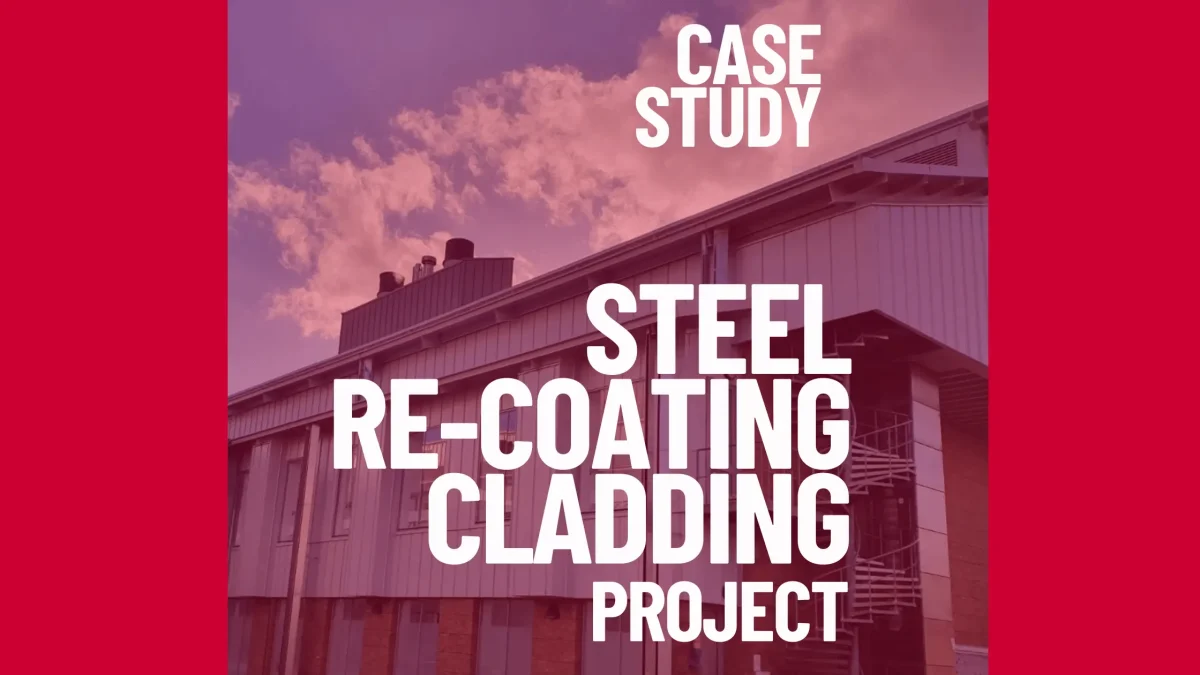
Plastisol cladding serves as both the decorative and protective outer envelope of commercial buildings. When it deteriorates, through chalking, fading, delamination, or corrosion at cut edges, the building's appearance and weather resistance are both compromised. Full panel replacement is the most expensive solution; recoating the existing panels on-site is the alternative that most building owners, facilities managers, and property managers choose.
This guide explains what Plastisol cladding is, why it deteriorates, why standard paints should not be used on it, and the correct twelve-step process for a professional, durable recoat.
Plastisol is a coating material made from polyvinyl chloride (PVC) particles suspended in a plasticiser, heated during manufacture to form a solid, flexible film. When applied to profiled steel panels in a factory, it produces a coating that is:
Plastisol has been the dominant cladding finish for industrial and commercial buildings in the UK since the 1970s, and the majority of the single-storey commercial building stock in this country carries a Plastisol or Plastisol-derived cladding finish of some description.
Despite its initial durability, Plastisol degrades progressively over time:
Do not ignore cut-edge corrosion. Rust spreading from panel edges beneath the existing Plastisol coating will not be stopped by painting over the top. Cut-edge corrosion must be treated with a specialist sealant as part of the preparation process before any topcoat is applied, otherwise the new coating will delaminate along the same path as the old one within a few years.
The most consequential decision in any Plastisol cladding recoat project is the choice of coating system. Using an unsuitable product is the single most common cause of early failure in cladding recoat work, and it is completely avoidable.
Standard paints, latex, water-based emulsion, oil-based alkyd, or general-purpose acrylic, are not formulated for Plastisol substrates. Specific problems include:
The correct product is a specialist cladding topcoat, a purpose-formulated coating system designed specifically for Plastisol and steel substrates, with proven adhesion, flexibility, UV stability, and long-term weather resistance. Applied over a compatible bonding primer, this is what delivers 10–15 years of service life on a professional recoat programme.
Update, advances in cladding coating technology: Modern specialist cladding systems have significantly extended achievable warranty periods compared to products available a decade ago. Depending on the topcoat system selected, the substrate condition, and the site location, extended warranties of up to 15 years are now available, substantially exceeding what was possible with earlier product generations. A professional contractor will specify the appropriate system based on your building's exposure classification and the client's warranty requirements.
The following is the correct sequence for a professional Plastisol cladding recoat. The temptation to shortcut preparation is strong, particularly under time or budget pressure, but preparation quality directly determines how long the new coating lasts. A properly prepared surface with the right coating system will last 10–15 years; a poorly prepared surface will begin to fail within two or three.
All flaking, delaminating, or bubbling sections of the existing Plastisol coating must be removed before preparation begins. Wire brushing and hand scraping are suitable for localised areas of failure. Where large areas of the surface have failed, particularly common on buildings more than 20 years old, grit blasting or soda blasting may be required to return the panels to a clean, sound substrate. Only intact, well-adhered sections of the existing Plastisol should remain; loose areas must be taken back completely.
Inspect all panel edges, top, bottom, and sides, and all fixing points for evidence of cut-edge corrosion. Rust staining, lifting at panel edges, and blistering adjacent to fixings are the typical signs. Where corrosion is found, the affected area must be cleaned back to sound metal and treated with a specialist cut-edge corrosion sealant before any painting begins. This step is carried out by experienced professionals, not as a DIY measure.
The entire cladding surface must be cleaned with a specialist degreasing agent to remove mould, atmospheric dirt, oils, grease, and any other contamination. In industrial environments, surfaces may carry a film of process residue or airborne oils that are not visible to the eye but will completely prevent paint adhesion. In cases of biological contamination, algae or heavy mould growth, a sterilisation wash with a biocidal cleaner should precede the standard degreasing step.
All cleaning and degreasing products must be rinsed from the surface, residual cleaning agents left on the panels will interfere with primer adhesion. Allow the surface to dry completely. On exterior cladding this means waiting for an appropriate weather window; the surface temperature must also be above the dew point before any coating is applied to prevent condensation forming on the panel face during application.
The intact Plastisol surface must be abraded to provide mechanical adhesion for the primer. A suitable abrasive pad or fine-grade sandpaper is used to break the gloss and key the surface across the full area. Edges of areas where coating has been removed should be feathered, abraded to a gradual taper, so there is no visible step or edge between the bare metal area and the remaining Plastisol, which would be visible through the new topcoat.
Dust from abrasion must be removed before priming. Blow down or brush away loose dust, then wipe the surface with a clean tack rag. Any dust particles left on the surface will be encapsulated in the primer film, producing a rough texture and reducing the quality of the final finish. This step is particularly important on profiled cladding where dust can collect in the troughs of the profile and is not always visible from a standing position.
All areas not to be coated, windows, doors, gutters, fascias, ground areas adjacent to the building, and any other surfaces that could receive overspray, must be masked before spraying begins. On occupied commercial premises, cars, equipment, and any neighbouring property must also be protected. The extent of masking required depends on wind conditions and the proximity of adjacent surfaces; in tight locations, containment sheeting may be required around the entire working area.
The bonding primer is the most technically critical product in the entire system. It must be specifically compatible with Plastisol, a standard metal primer or etch primer will not achieve adequate adhesion to the plasticised PVC surface. The primer is applied by airless spray to ensure even coverage across the full corrugated profile, including all troughs and ribs. Allow full cure to the manufacturer's minimum overcoating time before applying the topcoat.
The topcoat must be a specialist cladding coating, not a standard decorative or industrial paint. Modern specialist cladding systems are available as single-pack or two-pack formulations with extended warranty options. The coating supplier will specify the correct product based on the substrate (Plastisol or mixed), the building's exposure classification (inland, coastal, industrial), the required colour, and the warranty period requested. Colour choice affects warranty duration, deep and dark colours absorb more solar heat, which accelerates thermal cycling stresses in the coating film.
The first topcoat is applied by airless spray. Correct gun distance (typically 30–35cm from the panel face), overlap, and stroke speed are maintained throughout to produce a uniform film across the full corrugated profile. Application must avoid overloading the troughs, runs in inaccessible troughs are difficult to correct and visually prominent on the finished surface. Allow to dry for approximately four hours, or the manufacturer's stated flash-off time, before proceeding.
Depending on the specific topcoat product and the condition of the substrate, a light abrasion between coats may be required to improve inter-coat adhesion. This is particularly relevant where the first coat has been applied over bare metal areas. Remove any sanding dust before applying subsequent coats. Follow the manufacturer's overcoating window, applying the second coat too soon or too late relative to the first can affect adhesion and final finish quality.
The final coat brings the surface to full colour depth and achieves the specified dry film thickness. Application technique for the final coat requires particular attention, this coat determines the visual quality of the finished surface. Consistent gun speed and overlap, correct pressure, and appropriate environmental conditions (temperature, humidity, wind speed) are all critical. Once cured, the new coating is inspected for coverage, colour consistency, and any areas requiring touch-up before masking is removed and the site is cleared.
The decision between recoating and replacing Plastisol cladding panels comes down primarily to the structural condition of the existing panels. Where panels are intact, well-adhered to the building frame, and free of major corrosion or physical damage, recoating is almost always the better choice. Where panels are severely corroded, structurally compromised, or thermally degraded to the point where the base metal is losing integrity, replacement is necessary regardless of cost.
| Factor | Recoating | Panel replacement |
|---|---|---|
| Cost | 20–30% of replacement cost | Full replacement, panels, labour, waste disposal |
| Disruption | Minimal, building remains in use | Significant, building envelope opened, operations affected |
| Time on site | Days to weeks depending on area | Weeks to months for large buildings |
| Service life achieved | 10–15 years with correct system | 25+ years (new panels with new factory finish) |
| Environmental impact | Low, no panel waste generated | High, existing panels to landfill, new panel manufacturing |
| Suitability | Panels structurally sound, coating failed | Panels structurally compromised or severely corroded |
At Vanda Coatings, we have been recoating Plastisol cladding on commercial and industrial buildings across the UK for nearly three decades. Every project begins with a thorough condition survey to assess the existing coating, identify any corrosion or structural issues, and specify the correct primer and topcoat system. We work with the leading specialist cladding coating manufacturers to ensure every project uses products appropriate to the substrate, the environment, and the client's warranty requirements.
Plastisol is a thick, flexible coating made from PVC particles suspended in a plasticiser, heat-cured during manufacture to produce a solid film on profiled steel panels. It has been widely used as a building cladding finish since the 1970s, offering good impact resistance, flexibility, and initial weather protection. Over time it degrades through UV exposure, thermal cycling, and cut-edge corrosion, all of which can be addressed through professional on-site recoating.
Yes. Plastisol-coated cladding can be successfully recoated on-site without panel replacement, provided the substrate is in reasonable structural condition and the preparation process is followed correctly. A primer specifically compatible with Plastisol is required before the topcoat is applied. Using a standard or incompatible primer is the most common cause of adhesion failure in cladding recoat projects.
Standard decorative paints, latex, emulsion, oil-based gloss, are unsuitable. A specialist cladding coating system is required: a Plastisol-compatible bonding primer followed by a purpose-formulated cladding topcoat. Modern specialist systems offer extended warranties of up to 15 years depending on the product, colour, and site exposure conditions.
A correctly prepared and applied specialist cladding coating system will typically provide 10–15 years of service life on Plastisol panels. The key factors are preparation quality, thorough degreasing, keying, and correct primer application, and the use of a cladding-specific topcoat. Cut-edge treatment is also critical; failing to seal panel edges is the primary cause of premature failure in recoat programmes.
Replacing cladding panels requires removing all existing panels, disposing of them, installing new panels, and resealing the building envelope. Recoating requires none of this structural work, the preparation and coating is applied to the panels in place. The result is a cost that is typically 20–30% of like-for-like panel replacement, with minimal disruption to building operations.
Access requirements depend on the building height and configuration. For single-storey industrial buildings, mobile elevated work platforms or tower scaffolding are typically sufficient. For multi-storey commercial buildings, full scaffolding or rope access may be required. A professional on-site spraying contractor will assess access requirements as part of the initial site survey and factor the appropriate access method into the project programme and cost.

Related articles on cladding and surface coatings.
What PVF2/PVDF cladding is, how it differs from Plastisol, and the correct approach to recoating over an existing fluoropolymer finish.
Read ArticleYes, interior metal cladding in warehouses, factories, and industrial units can be successfully recoated on-site. Here is how.
Read ArticleOur on-site cladding recoat service, full preparation, cut-edge corrosion treatment, specialist primer and topcoat, warranty available.
View ServiceSee It In Practice
See how we transformed failing, chalking cladding at occupied commercial premises in Bristol, restoring the facade to a consistent professional finish.
View Case StudyWe carry out commercial and industrial cladding recoat programmes across the UK. Tell us about your building, substrate, and requirements, we will survey the site, specify the correct coating system, and provide a written quotation.