Roller Shutter Door Painting
Ten reasons why roller shutter doors should be sprayed, and how the preparation and application process works for this specific door type.
Read ArticleEvery commercial and industrial building in the UK has at least one industrial door, and over time, every one of those doors will need recoating. This guide covers the different door types, why on-site spray painting outperforms replacement on cost, what preparation is needed, and how the application process works in practice.
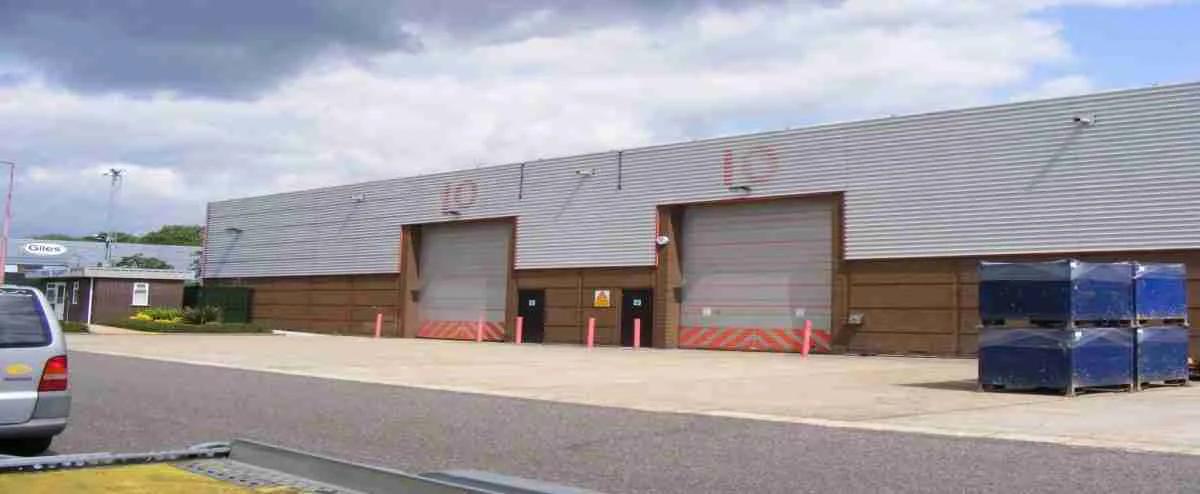
There are an enormous number of commercial buildings in the UK, warehouses, factories, retail outlets, distribution centres, light industrial units, car dealerships, food production facilities, and every single one of them has at least one industrial door. After a period of time, industrial door spray painting becomes necessary: the original factory coating fades, chips, or corrodes, and recoating is the most cost effective way to restore both appearance and protection.
Unlike replacement, on-site spray painting keeps the existing door mechanism in place, avoids structural disruption, and can be completed with minimal operational downtime. For most commercial premises, recoating is the right decision by a significant margin, both financially and practically.
Commercial and industrial premises use a wide variety of door types depending on building function, security requirements, and access patterns. The good news is that nearly all of them can be recoated on site.
The most common type on any commercial premises, providing access for staff and visitors. Constructed from steel, aluminium, or timber-framed with steel facing. Fire doors in this category are critical safety features and are frequently recoated to maintain compliance with site standards. Spray painting restores appearance and corrosion protection without affecting door function or fire rating.
Individual interlocking horizontal panels roll into a tube above the door opening, saving internal headroom while providing secure closure. Manufactured in galvanised steel or aluminium, with a factory-applied powder coat or plastisol finish. As the original finish ages, on-site respraying in any RAL or BS colour restores both protection and visual appeal. One of the most frequently recoated door types we work with.
Sometimes called "up and over" doors, these open by hinging individual panels upward into the roof space. Commonly installed on loading bays, vehicle workshops, and larger industrial units. Affordable, efficient, and secure, and well-suited to on-site respraying once the original coating has aged or been mechanically damaged through operational use.
These can be installed in virtually any commercial building where a swinging or roller shutter design is impractical. Variants suit environments from unheated industrial warehouses to temperature-controlled production areas and food facilities. The door panels are straightforward to abrade and recoat on site, with masking applied to tracks, hardware, and seals before spraying.
Specialist doors that can open at up to 2 metres per second, used in food production, pharmaceutical, and logistics environments where traffic flow and hygiene control are critical. Opening is triggered by pull cords, radar sensors, or loop detectors. The door frame and surrounding metalwork are the primary recoating targets on this door type, the fast-action mechanism itself is typically left clear.
Retractable grilles or gates fitted over windows and entrances, typically manufactured in galvanised steel and originally finished in polyester powder coat. The open lattice structure of security grilles makes brush painting impractical, spray application is the only method that achieves even coverage across the full profile. On-site respraying is straightforward with thorough masking of adjacent glazing and surfaces.
The decision between recoating and replacing an industrial door comes down to whether the door mechanism is sound. If the door opens, closes, seals, and operates correctly, and the issue is with the coating rather than the structure, recoating is almost always the right answer.
| Factor | On-site recoating | Full replacement |
|---|---|---|
| Typical cost | 60–80% lower than replacement | High, door, delivery, installation, making good |
| Operational disruption | Minimal, doors recoated in situ, overnight or weekend working available | Significant, door out of commission during fitting |
| Lead time | Typically 1–5 days from survey to completion | Weeks, manufacture, delivery, installation scheduling |
| Structural work | None, no modifications to frame or building fabric | Required, removal, frame adjustment, making good |
| Result lifespan | 8–12 years from a properly applied 2K acrylic system | 15–20+ years from a new door with fresh factory coating |
| Best suited when | Mechanism sound; coating faded, chipped, or corroded | Mechanism failed; door structurally compromised; end of service life |
Understanding the failure mechanisms helps explain why periodic recoating is necessary, and why delaying it increases the eventual cost of remediation.
Delaying recoating increases remediation cost. A small area of corrosion on a steel door panel is a preparation item on a recoating project. Left untreated, corrosion spreads under the existing film, sometimes invisibly, until the structural integrity of the panel is affected. At that point, recoating is no longer sufficient and panel or door replacement becomes necessary. Early recoating is almost always the more cost effective decision.
Vanda Coatings applies a 2K acrylic (two-pack acrylic) coating system by airless spray on commercial and industrial door projects. This is the industry-standard coating for on-site metalwork respraying, chosen for its combination of adhesion, durability, chemical resistance, and colour stability.
The system typically comprises:
2K acrylic is a two-component system, a base and a hardener, that cross-links chemically as it cures. This produces a film significantly more durable than single-pack coatings: better abrasion resistance, better chemical resistance, better colour retention, and a substantially longer service life. On correctly prepared metalwork, a well-applied 2K acrylic topcoat typically lasts 8–12 years before recoating is needed.
No isocyanate hardeners. Vanda Coatings uses non-isocyanate 2K acrylic systems on all commercial and industrial door projects. This avoids the significant respiratory sensitisation hazards associated with isocyanate-based coatings, without any compromise to film performance or durability.
Every industrial door recoating project follows the same sequence, the preparation stage is the most labour-intensive and the most critical determinant of how long the finish lasts.
We visit the site before submitting a quotation. The survey establishes: door types and quantities, substrate material and current coating condition, extent of any corrosion or mechanical damage, access requirements, and operational constraints (working hours, security, adjacent activities). The specification is written from the survey findings, not assumed from a phone description.
All surfaces adjacent to the doors being recoated, frames, floors, glazing, panels, hardware, hinges, handles, locks, and weather seals, are masked with decorator's tape and protective sheeting. On roller shutter doors, the guide channels and bottom bar mechanism are masked separately. Thorough masking is not a shortcut area: overspray contamination on unmasked surfaces is one of the most common causes of dispute on painting projects.
The door surface is cleaned with specialist degreaser applied by cloth or brush to remove oils, traffic film, handling contamination, and any surface salt deposits. The degreaser is fully wiped off with clean cloths, residue left on the surface interferes with primer adhesion. This step cannot be skipped regardless of how clean the door appears visually.
Existing coatings are abraded using orbital sanders, hand blocks, or wire-cup attachments depending on surface type and condition. Powder-coated surfaces require full abrasion to remove gloss and create a mechanical key for the primer. Areas of corrosion are wire-brushed back to clean metal. Dents, scratches, and minor surface defects are filled and feathered where appropriate. On bare galvanised steel, preparation includes removal of zinc salts ("white rust") before etch priming.
Primer is applied by airless spray immediately after preparation, exposed bare metal must not be left overnight before priming. Etch primer is applied to bare galvanised, aluminium, or steel surfaces. Adhesion primer is applied over abraded existing coatings. Primer coat is allowed to flash off fully before topcoats are applied, flash-off time varies by product and ambient conditions.
2K acrylic topcoat is applied by airless spray in two passes, typically two full coats to achieve the specified dry film thickness. The hardener is mixed into the base coat immediately before application; pot life after mixing is typically 4–6 hours at normal ambient temperatures. Spraying technique is critical: consistent gun distance, correct overlap, and a lag-stroke approach at each end of the pass to prevent runs and heavy edges.
Masking is removed carefully once topcoats have cured sufficiently, typically within 2–4 hours at ambient temperature, depending on conditions. The completed door is inspected against the film build specification and appearance standards before the site is cleared. Any touch-in required at masked edges is completed before the operatives leave site. A written project record is provided on request.
The vast majority of industrial door types can be recoated in situ, including roller shutter doors, sectional overhead doors, personnel entrance doors, sliding and folding doors, and steel security grilles. The feasibility depends on substrate material, condition of the existing coating, and site access. Most galvanised steel, powder-coated, and primer-finished doors are suitable candidates. Our operatives assess each installation before specifying the correct preparation and coating approach.
In the large majority of cases, yes. On-site spray painting is typically 60–80% less expensive than full door replacement, with none of the structural disruption or extended lead time that replacement involves. The economic case for recoating is strongest where the door mechanism is sound but the coating has degraded, which describes most industrial door repainting enquiries we receive.
We use a 2K acrylic (two-pack acrylic) coating system, applied by airless spray. The system consists of an appropriate primer followed by one or two topcoats of 2K acrylic in the specified colour and finish. 2K acrylic is the industry standard for commercial metalwork: it offers excellent adhesion, chemical resistance, colour stability, and a typical service life of 8–12 years when properly applied over a prepared substrate.
Timescale depends on door type, quantity, condition, and preparation extent required. A single personnel door in reasonable condition can typically be recoated within a day, including preparation, masking, primer, and two topcoats. A programme of roller shutter doors on a larger industrial estate would be planned as a multi-day or phased project to allow recoated doors to return to service while others are in progress. We provide a programme schedule with every commercial quotation.
Yes, for occupied commercial and industrial premises, we regularly schedule door repainting programmes outside normal operating hours, including overnight and weekend working. Many of our roller shutter and industrial door projects on retail parks, distribution centres, and manufacturing facilities are planned specifically around the client's operational requirements to avoid any disruption to loading, access, or security.
Thorough preparation is the most important factor in coating longevity. This always includes degreasing the substrate. On bare galvanised steel, an etch primer is applied to bond with the zinc. On existing powder-coated surfaces, mechanical abrasion creates a key for the primer. Any corrosion, pitting, or mechanical damage is addressed before topcoats are applied. All surrounding hardware, seals, and adjacent areas are masked prior to spraying.

Related articles on commercial metalwork and door recoating.
Ten reasons why roller shutter doors should be sprayed, and how the preparation and application process works for this specific door type.
Read ArticleHow to recoat steel fire exit doors correctly, preparation, priming, topcoat specification, and compliance considerations for occupied commercial buildings.
Read ArticleOur on-site roller shutter door recoating service, full preparation, 2K acrylic system, any RAL colour, overnight and weekend working available.
View ServiceSee It In Practice
See how we recoated 36 lift door faces across a live occupied office building, staged to avoid disruption to building occupants.
View Case StudyFree site surveys and quotes for industrial door spray painting projects across the UK. Tell us your door types, quantities, location, and any operational constraints and we'll put together a programme that works around your business.