Ceiling Tile Restoration
How suspended ceiling tiles are restored by on-site spray painting, the process, advantages over replacement, and what types of tiles can be recoated.
Read ArticleWhat soffits are, why they deteriorate in commercial environments, the correct preparation and spray application process, and how professional on-site soffit painting modernises entire interiors, without business disruption.
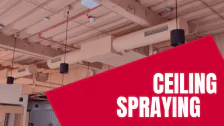
A soffit is the visible underside of an architectural element, the most common in commercial buildings being the recessed sections of ceilings above open-plan areas, the undersides of beams and staircases, and the horizontal surfaces at the junction of ceiling and structural frame. After years of exposure to dust, HVAC emissions, lighting heat, and general atmospheric contamination, soffits become discoloured, chalky, and visually degraded in a way that undermines the overall appearance of even well-maintained commercial interiors.
Recoating soffits by on-site spray application is one of the most cost effective interventions available to facilities managers. It transforms the appearance of large interior spaces quickly, without structural work, without the waste of replacement, and, when carried out professionally, without meaningful disruption to the building's day-to-day operation.
The term derives from the French soffite, itself from the Italian soffitto, meaning "fastened underneath." In architecture, a soffit is any surface forming the underside of an overhead structure. In commercial building terminology, the most commonly encountered soffits are:
In practice, facilities managers most frequently request soffit painting as part of a broader ceiling refurbishment, addressing the framing elements around suspended ceiling tile fields, recessed lighting zones, and the perimeter junction between ceiling and wall.
Soffits in commercial environments are exposed to conditions that degrade coating systems far faster than equivalent surfaces in domestic buildings. The primary causes of deterioration are:
The reflectivity problem. A clean white soffit reflects substantially more light into the space below than a stained or chalked surface. In buildings where lighting levels are specified at design stage, a deteriorated ceiling surface can push ambient lux levels below the required minimum, leading to either occupant complaints or unnecessary energy expenditure as more artificial light is used to compensate. Recoating restores the designed reflectivity without any change to the lighting installation.
The substrate type determines the correct surface preparation and coating system. The most common commercial soffit materials Vanda Coatings encounters are:
Most common in offices, healthcare, and education buildings. Plasterboard soffits accept water-based acrylic coatings readily after preparation. Any cracks or surface imperfections must be filled and feathered before coating. Bare or previously unpainted plasterboard requires a mist coat or sealer to prevent excessive absorption of the topcoat.
Common in retail, distribution, and industrial buildings. Metal pan soffits are durable but prone to surface corrosion on steel panels if the existing coating has broken down. Aluminium panels require appropriate adhesion promotion, a bonding primer or etch coat, to ensure the coating system adheres correctly. Galvanised steel surfaces require a dedicated primer that keys to the zinc layer.
Found in car parks, industrial units, and some modern commercial buildings with exposed structure aesthetics. Concrete soffits may carry laitance, a weak surface layer that must be abraded or treated before coating. Any active carbonation, cracks, or areas of failed coating must be addressed before decoration to ensure the new system bonds correctly and achieves its intended service life.
Encountered in older commercial interiors, retail fit-outs, and hospitality venues. Timber soffits require any knots to be sealed with shellac-based knotting compound before coating to prevent resin bleed-through. MDF edges must be primed separately as they are significantly more absorbent than face surfaces.
Professional on-site soffit painting is not simply a matter of applying paint from a spray gun. A structured process, from protection of the working environment through to final inspection, is what separates a lasting, high quality result from one that fails prematurely or creates unnecessary disruption.
All furniture, fixtures, fittings, equipment, and floor surfaces within the work area are covered with polythene sheeting before any spray equipment is set up. Smoke detectors, sprinkler heads, lighting fixtures, and ventilation grilles are individually masked. Any items that cannot be protected in situ are temporarily relocated. The objective is to ensure the spray application affects only the intended surfaces, nothing else in the building requires cleaning or rectification after the work is complete.
The soffit surface is inspected for adhesion of the existing coating, surface contamination, cracks, corrosion (on metal substrates), and any areas of delamination or bubbling. Failed areas of existing coating are abraded back to a sound substrate. Dust, grease, and surface contamination are removed using appropriate cleaning agents. Cracks and imperfections are filled. Metal surfaces are assessed for corrosion and treated as required before a compatible primer is applied.
The need for a primer coat depends on the substrate condition and the coating system being applied. Bare or sealed plasterboard, bare metal, and any areas taken back to raw substrate all require priming before the topcoat. Primer selection is specific to the substrate, etch primers for bare aluminium, zinc-compatible primers for galvanised steel, and penetrating primers for high-porosity concrete or plaster surfaces. Applying the correct primer ensures topcoat adhesion and prevents premature failure.
Depending on the soffit height and accessibility, operatives use access towers, ladders, or stilts to reach the work surface safely. Airless or HVLP spray equipment is selected based on the surface area, coating viscosity, and the presence of integrated elements such as lighting and ventilation. The soffit is coated in systematic passes, maintaining consistent gun distance and overlap to achieve uniform film build. Integrated elements, light bezels, grilles, and duct faces, can be coated simultaneously in matching or contrasting colours as specified.
After the first coat has reached the flash-off time specified in the product data sheet, a second coat is applied. Two coats are standard for a durable, uniform result. The completed soffit is inspected under multiple lighting angles to confirm consistent coverage, freedom from holidays, runs, or sags, and correct colour. Any areas requiring touch-in are attended to at this stage.
All masking and protection materials are carefully removed and bagged for disposal off-site. Smoke detectors, sprinkler heads, and ventilation grilles are unmasked and confirmed operational. Any protective coverings on furniture and equipment are removed. The work area is left clean and ready for immediate reoccupation, no drying time restrictions apply with modern water-based systems under normal commercial building temperature and ventilation conditions.
For commercial soffits, particularly those incorporating profiled sections, integrated lighting zones, and architectural detail, spray application consistently outperforms brush and roller on every relevant criterion.
| Factor | Spray application | Brush & roller |
|---|---|---|
| Finish quality | Uniform film, no brush marks or roller texture | Brush marks and stipple texture visible, particularly on smooth substrates |
| Coverage on profiled surfaces | Excellent, coating reaches recesses, shadow lines, and complex profiles | Difficult, brush must work into every recess individually; uneven coverage likely |
| Application speed | Substantially faster on large areas, 3–4× quicker than brush on open soffits | Slow, labour-intensive, particularly at ceiling height |
| Uniformity across large areas | Consistent film build across the entire surface | Operator-dependent, joins and lap marks common on large areas |
| Disruption to building | Requires thorough masking of adjacent areas | Lower overspray risk, less masking required |
| Integrated element coverage | Simultaneous coating of light bezels, grilles, and ducts in same operation | Each element requires individual brush work, significantly slower |
Soffit colour has a greater effect on the perceived quality of a commercial interior than many facilities managers appreciate at specification stage. The standard approach of painting all ceiling surfaces the same white creates a neutral, low-maintenance result. But intentional colour differentiation can achieve more sophisticated outcomes:
Finish level also affects both appearance and maintenance. Dead matt finishes are the most forgiving of surface irregularities and are standard for most commercial soffits. Eggshell and satin finishes are more durable in areas subject to occasional contact or cleaning, and provide a degree of additional light reflectivity compared to matt. Gloss finishes are rarely used on horizontal ceiling surfaces in commercial applications.
Vanda Coatings carries out commercial soffit painting across a broad range of building types, each with its own requirements and constraints:
At Vanda Coatings, every commercial soffit painting project begins with a free site survey. We assess the substrate condition, existing coating system, ceiling height, accessibility, and the programme constraints specific to your building. From this we produce a written specification and quotation, with a programme designed around your operational requirements, not ours.
A soffit is the visible underside of an overhanging or recessed architectural element, most commonly the lower horizontal face of a suspended ceiling section, the underside of a beam, staircase structure, balcony, or canopy. In commercial buildings, soffits are typically plasterboard, metal pan, timber boarding, or in-situ concrete. They form the framing elements around ceiling tile fields, recessed lighting zones, and perimeter ceiling-to-wall junctions.
In most commercial environments, water-based acrylic coatings are the standard choice, they are low-odour, quick-drying, and suitable for application in occupied buildings. Where a harder, more chemically resistant finish is specified, in food production, healthcare, or high-traffic areas, a two-component acrylic system provides greater durability. The specific primer and topcoat system is selected based on the substrate material and the environment in which the soffit sits.
Yes, on-site soffit painting is designed for occupied buildings. All adjacent surfaces, furniture, and equipment are fully protected with polythene sheeting before any spray application begins. Modern water-based coatings have very low VOC content and no strong chemical odour. Work is typically scheduled in phases or out of hours where business operations require it. Reoccupation is possible immediately after the masking is removed, there is no drying period that prevents normal use of the space.
Duration depends on the total surface area, ceiling height, substrate condition, and the complexity of integrated elements. A straightforward open-soffit area of 200–300 square metres is typically completed in a single working day by an experienced Vanda Coatings team, including masking, preparation, two-coat application, and reinstatement. More complex scopes, multi-level soffits with significant integrated detail, will require a longer programme. A free site survey provides the precise programme for your specific scope.
Any RAL or BS colour. White and off-white are most common as they maximise light reflectivity. Darker tones, charcoal, anthracite, are increasingly specified in retail and hospitality interiors to create a recessive effect that causes services and structure to disappear visually. Brand colours and wayfinding accent shades can also be applied. Finish levels range from dead matt through eggshell and satin depending on the specification.
Smoke detectors and sprinkler heads do not need to be isolated, they are individually masked at the start of the job and unmasked at completion. The masking process is carried out carefully to avoid triggering smoke detectors through disturbance. Where a building's fire safety management requires isolating detection zones during spraying operations, this is arranged in advance with the facilities manager and the relevant competent persons. Vanda Coatings is experienced in coordinating this as part of the project programme.

Related articles on commercial ceiling and interior coating.
How suspended ceiling tiles are restored by on-site spray painting, the process, advantages over replacement, and what types of tiles can be recoated.
Read ArticleWhy exposing and painting the ceiling void is an increasingly popular alternative to installing a new suspended ceiling, the practical guide.
Read ArticleOur full commercial ceiling spraying service, on-site application, any substrate, any colour, minimal disruption to building operations.
View ServiceFree site surveys and quotes for soffit painting and ceiling refurbishment projects across mainland Britain. Tell us your site location, surface type, and programme requirements and we'll design the right approach around your building.